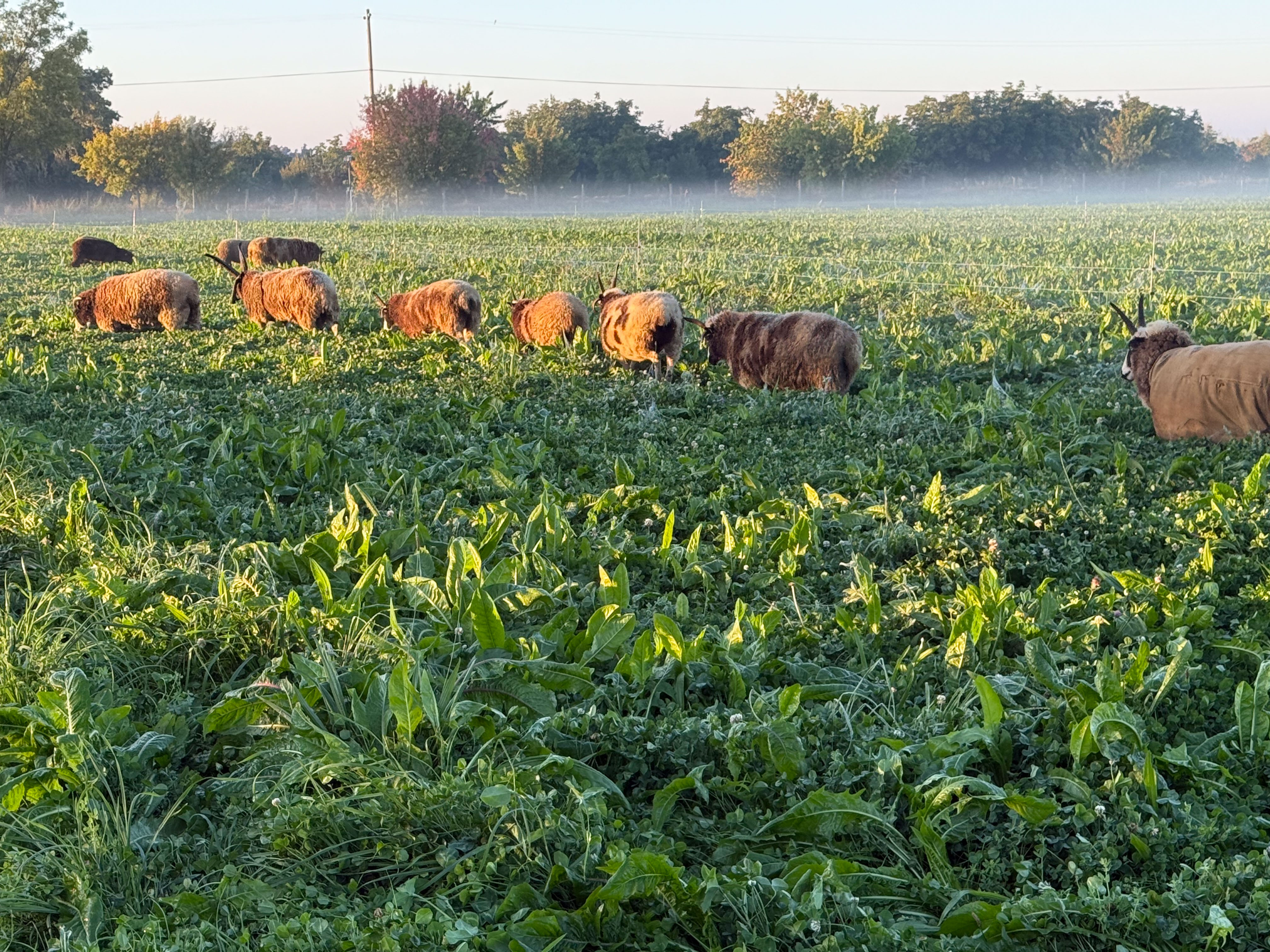
I went to the barn this morning planning to move the fence and open up the next paddock. It seemed a dramatic scene.
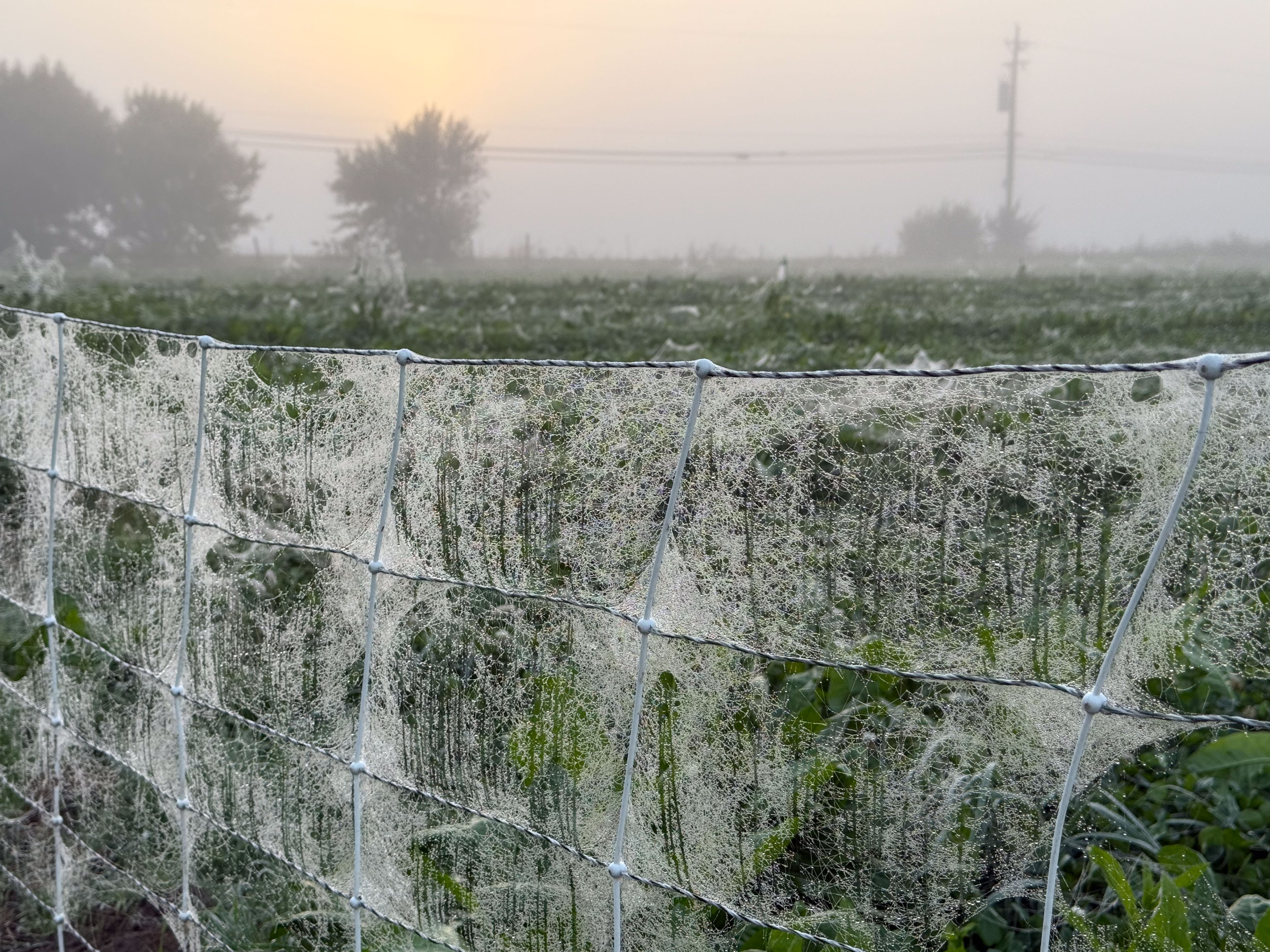
It was foggy, but was most obvious was the dew on the spiderwebs.
The spiderwebs seemed to be everywhere, especially obvious on the net fence.
The dew makes the webs much ore obvious.
This is only dew, no webs.
Later in the day the fog burned off and the dew was gone.
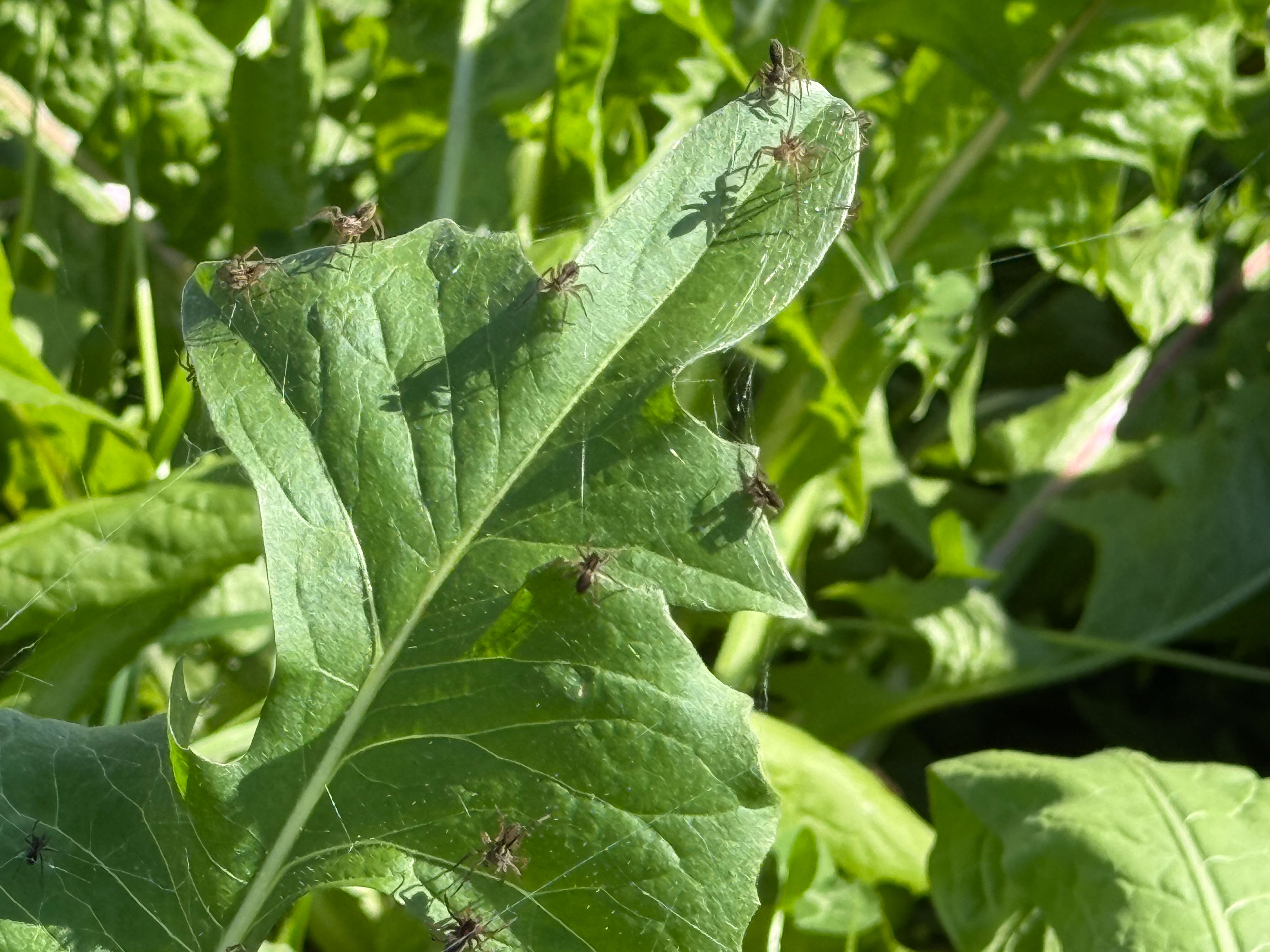
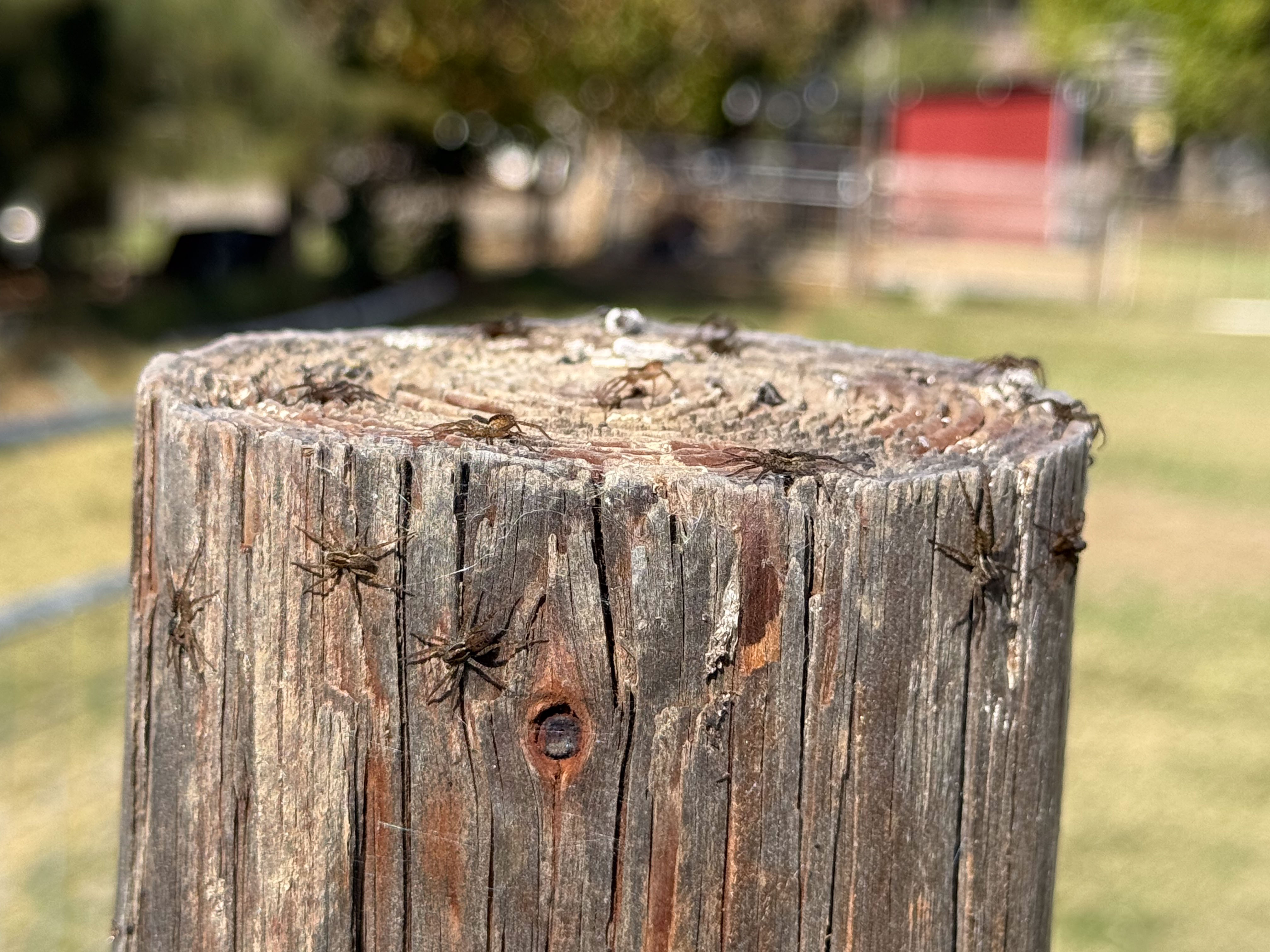
Here are the spiders that are responsible for what looks like webs. However they are not the typical web.
If you look up “spiders ballooning” you’ll find out that baby spiders will produce a strand or two of silk and be carried away by the wind. The net fence and the pasture plants easily catch those silk strands. So I don’t know how far those spiders have dispersed. Didi they start out here or elsewhere?
This morning’s view. I walked across the road to take this photo.
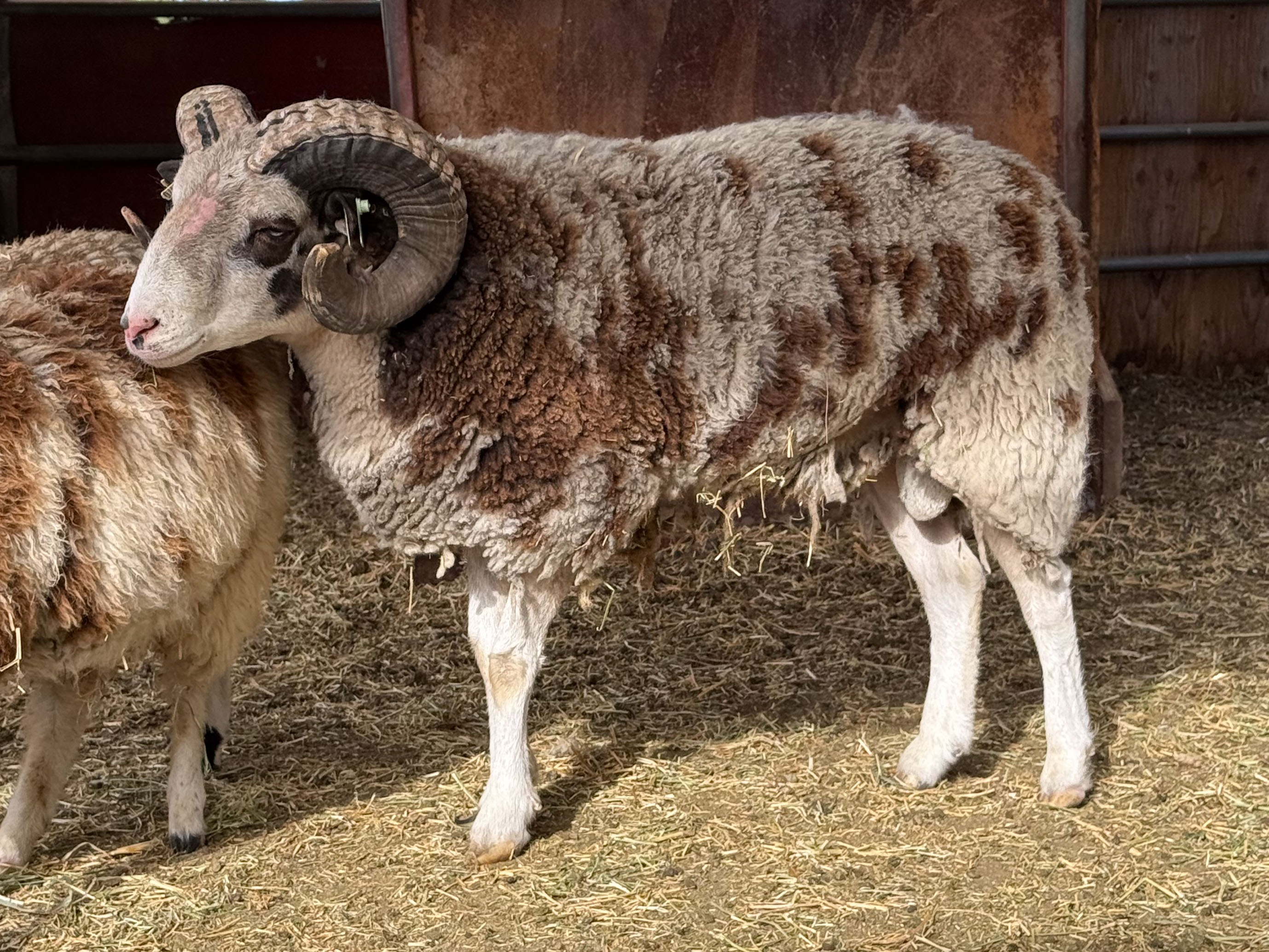
Back on our side of the road, this is the group of sheep with Hornblower, the 4-horn ram farthest back on the photo. They don’t need to be fed when they are on this pasture, still in great shape in late October. If you’re new to this blog and want to catch up on the pasture renovation start at the October 3, 2024 post and find 13 others titled Pasture and Irrigation Renovation and later 8 posts titled Grazing and Irrigation starting with this one in May, 2025.
On my way to the barn I stop and feed Tiger and Tippy. These are Dan’s garage cats, but I started feeding them in April after his knee replacement surgery. Now feeding cats is on my chore list, because they expect to be fed earlier in the day than Dan will come out. Each of these cats showed up here at different times (dumped or stray?) and now live here.
Breeding Season gets complicated because there are several groups of sheep. The next stop is the group of sheep with Clancy, the BFL. There are two significant points of this photo. One is the blue rear of the ewe in the back. She was the first marked September 27 but re-marked with blue at the next heat cycle. Also notice all that green behind the sheep. That is all new growth after that 2″ rain we had just 9 days ago.
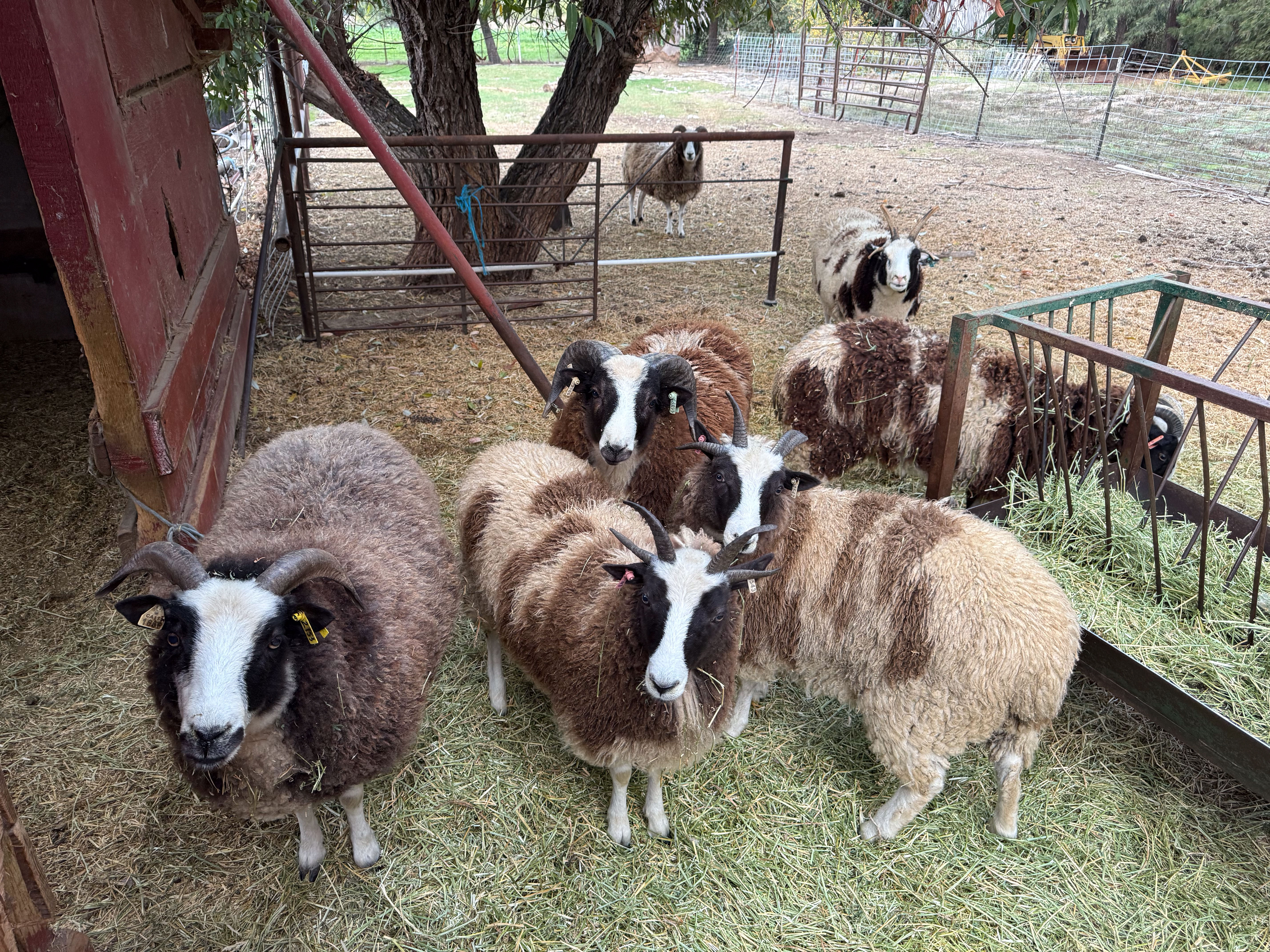
At the barn there are multiple groups. These are non-breeding sheep. Jade, in the back near the post, is the oldest sheep here and will live out her live as a pet. There are six others in this group. Sparky and 5 other lambs (some Meridian and some KJ Royalty, Kirby’s flock name) are here because I want to may want to choose some non-nursing yearlings next year if we decide to go to any shows.
This is another breeding group that has access to the north pasture.
Elvis is the ram with this group.
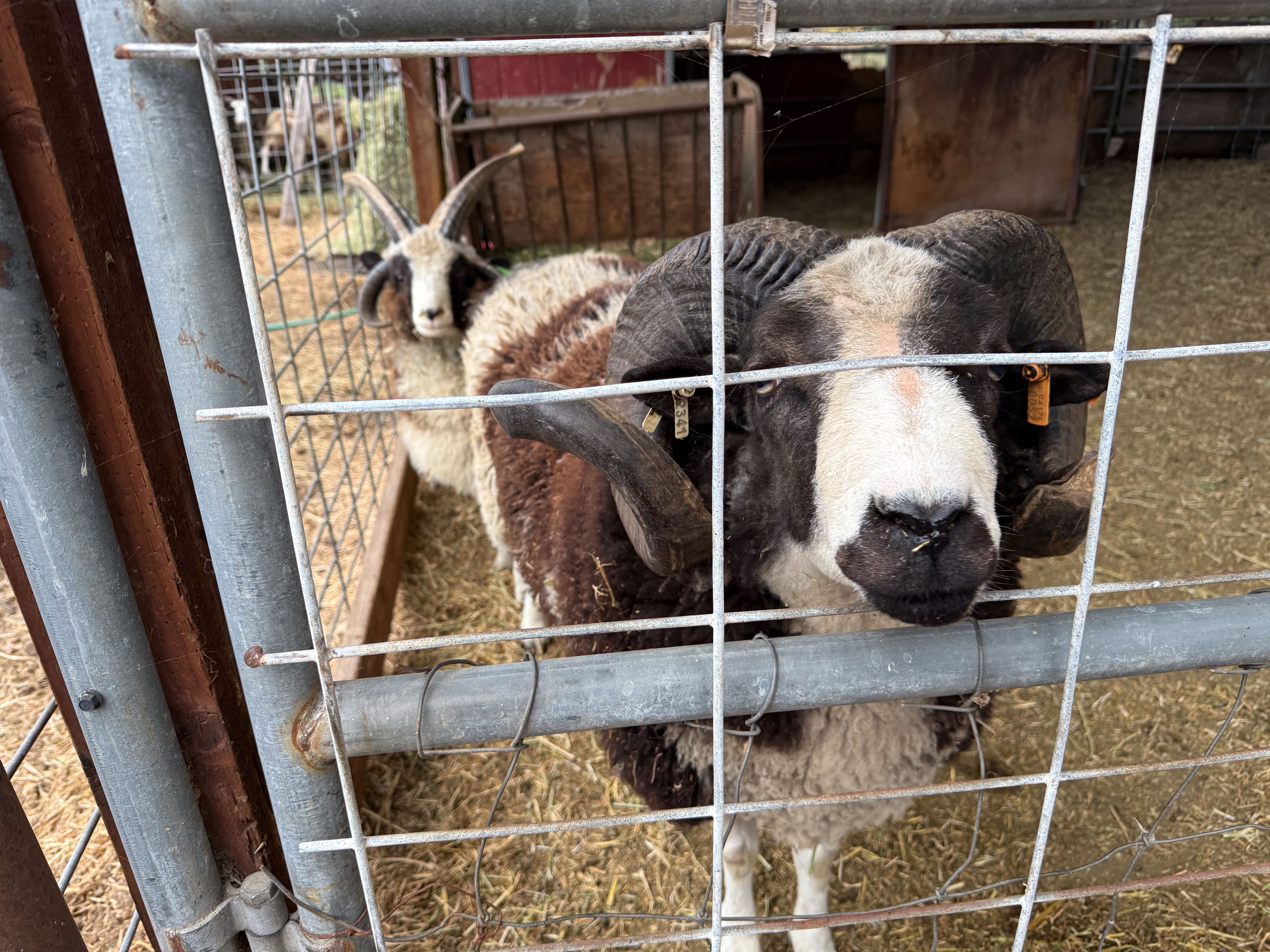
These are two young rams that I did not use to breed this year. The two horn ram is Meridian Dynamo. The four-horn is bide a wee Peregrin. He came from Oregon in September, was still on the young and small side, and I was able to get Starthist Hornblower, the adult 4-horn ram with the group in the pasture. So these guys will be in the line-up for next year.
Hunter is the two horn ram in the middle. He has six ewes.
I had two adult rams here, but one has been sold. Meridian Blizzard is hopefully sold and there is a ram lamb here that is the last of this year to be harvested for a customer.
I am ready to be done with Breeding Season, but when I look at the calendar I see that it has only been 3-1/2 weeks. I look forward to being able to put all the ewes back together and having them on the pasture together. There are challenges in putting the rams together, but I’ll deal with that when the time comes. For now they are all in separate places.
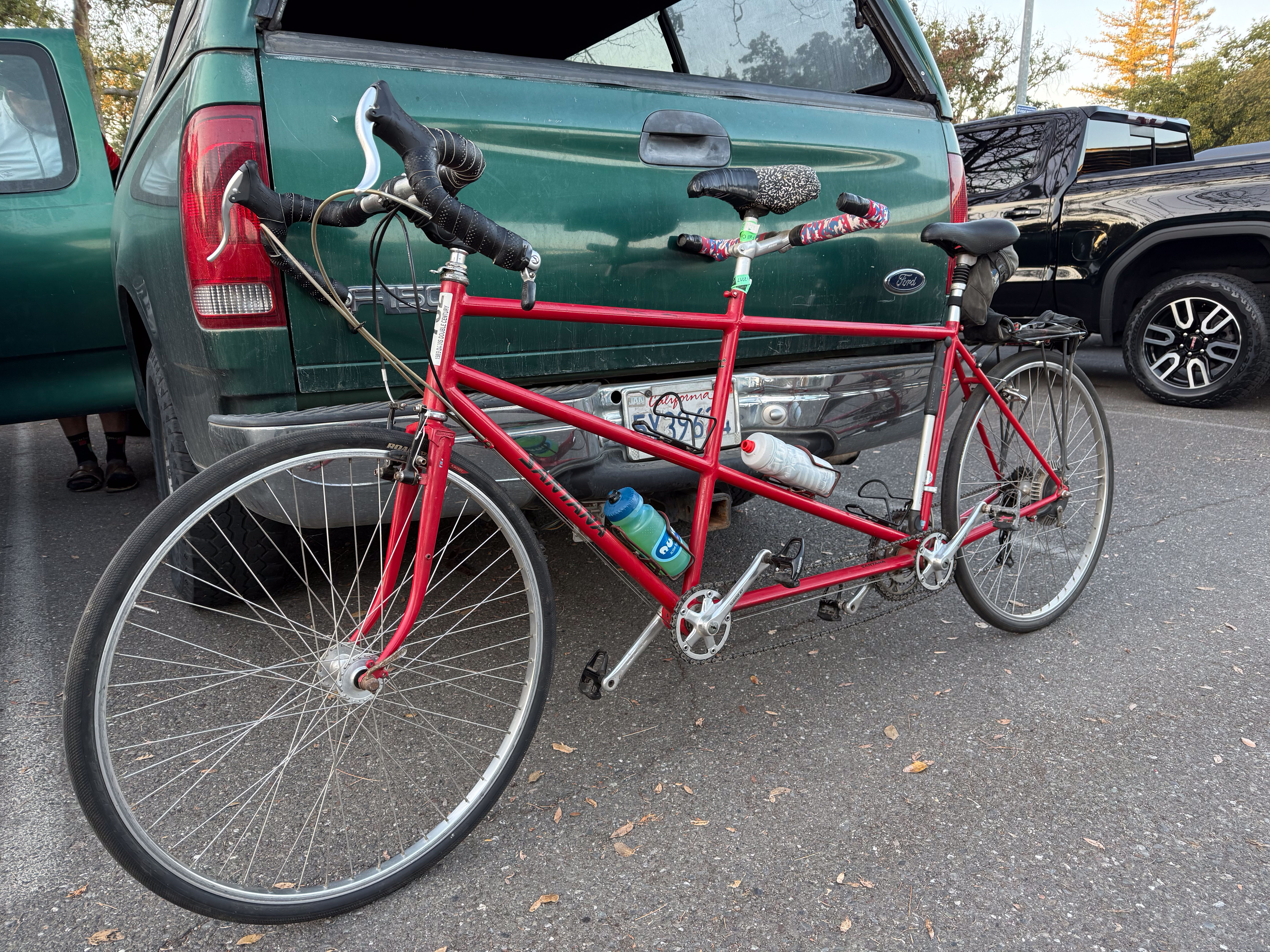
We have been riding the Foxy’s Fall Century for several years. I just looked back through blog posts to see if I could figure out when we started. In Foxy’s Fall Century 2015 I referred to this being a revival of a ride we used to do so I don’t know when we rode it the first time. Same bike. Same truck. The only other reference I found to Foxy’s is to a blog post about the three-year anniversary of the accident that could have changed all our lives. That post ends with a photo similar to many of these in today’s post. See that post on my website blog if you want to go off track and find out details of that accident and recovery.
Here is the tandem we bought when we were first married. We get a lot of comments. “Cool bike” “Beautiful bike”, etc. I’m not sure if people comment in the same way as car enthusiasts would comment on a ’67 Camero (which I had in college). In other words, this is an old bike as cycling trends go.
We did some good rides on this in the old days.
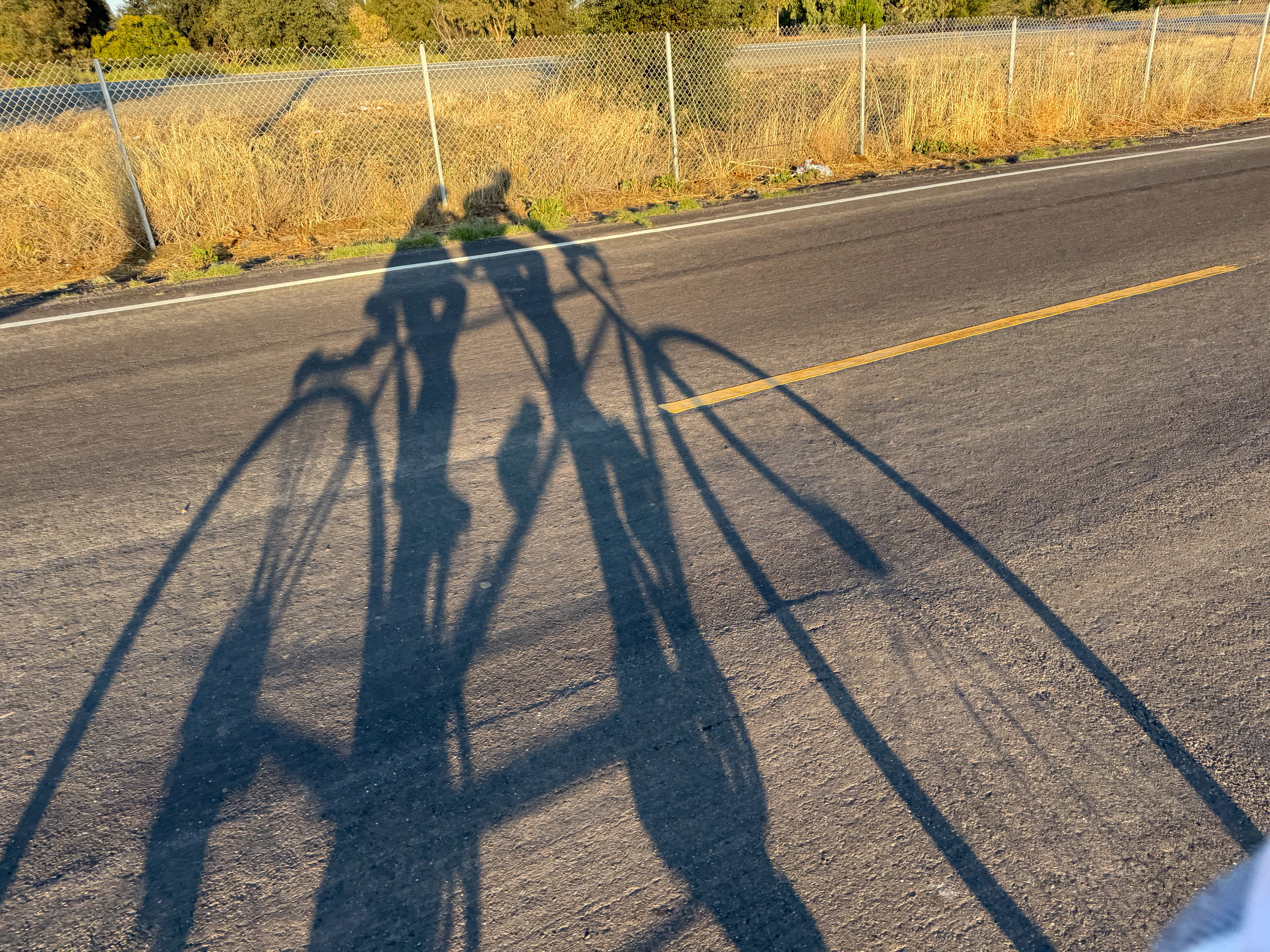
This is the only kind of photo I can get while we’re riding. The sun is low when we start so that’s the view–big bike, small people.
This is about 40 minutes later riding south. Those hills should be familiar from west-facing photos from our farm. We weren’t that far from home.
At the rest stop at Lake Solano near Winters. I took this photo because Dan’s brother texted while we were stopped there.
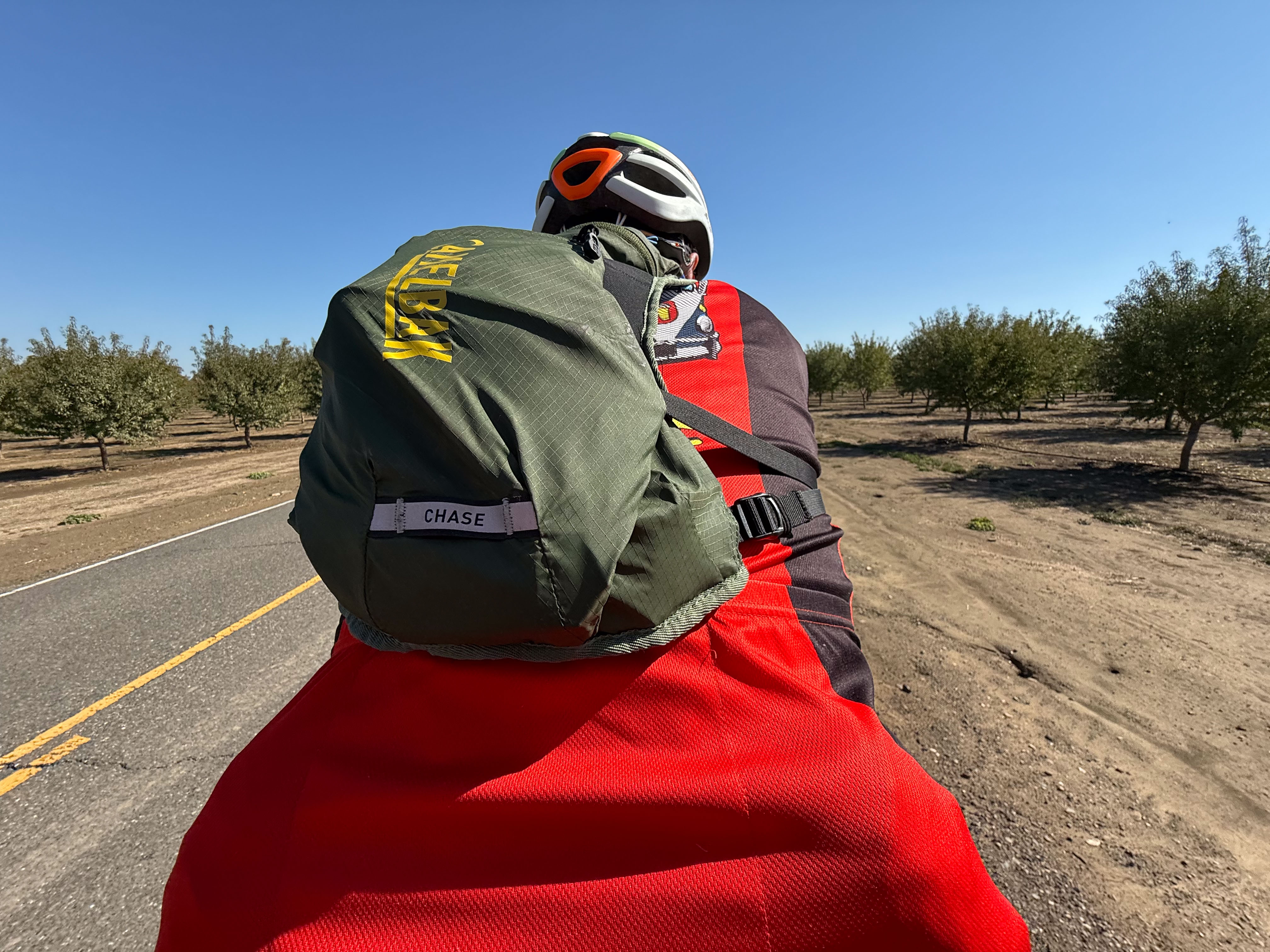
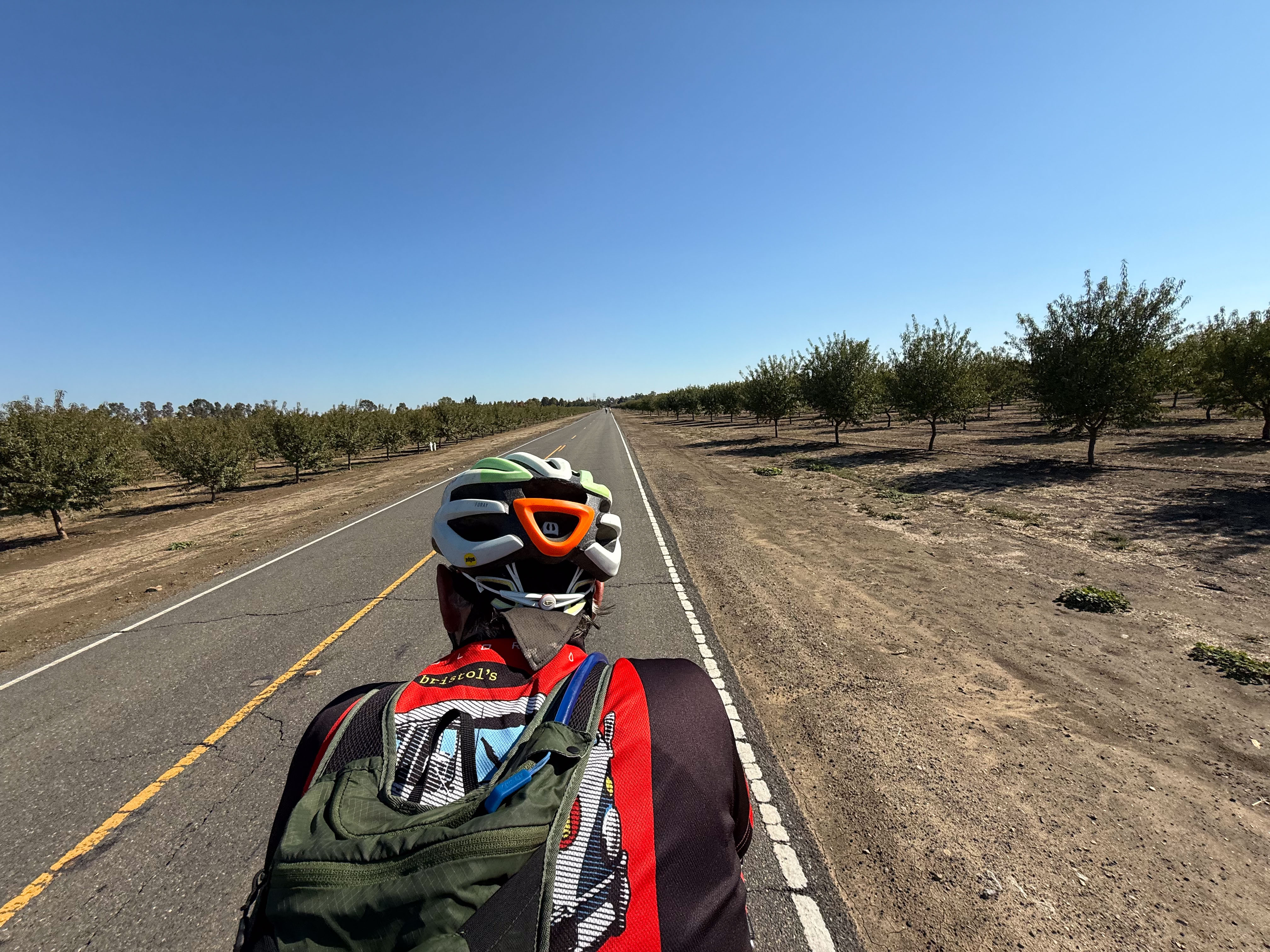
About 15 miles from Davis. This is the view I have while we are riding. Actually this is distorted. The phone photo would have shown only the green backpack canteen but I expanded the view a bit.
I held the phone above my head for this view.
Ride over. Back at the truck.
I feel fine, but maybe next year I’ll try to get a few miles in before the day of the ride.
As I’ve said before Breeding Season is a Season, overlapping the traditional seasons of summer and fall. If defining a Season influences how you live your life, Breeding Season definitely qualifies. It doesn’t take long before I’m ready for it to be over. It’s easier when all the ewes are in one place, the rams are somewhere else, and I don’t have to feed groups differently and watch my back when I’m with the ewes.
We have 4 breeding groups, a non-breeding group (the oldest sheep, Jade, and six ewe lambs), two young rams with potential for breeding (too young and/or small this year), and two older rams who are sold but still here. The breeding group with the most ewes is on the main pasture. Hornblower has about 30 ewes with him. Doesn’t that pasture look great?
Elvis has eleven ewes and is on the pasture to the north. When I moved the Hornblower group to the next paddock of the south pasture I needed to separate the two groups with more than a single net fence, especially since I’m having some issues with the power to the north one. So I set up two fences and was able to power the north one from the south one.
Those pasture photos were taken October 10. On the 13th it rained. We had 1.6″ the first day and .5″ the second day. A significant rainfall usually marks the end of grazing. It is late in the year and the pasture is depleted or dormant. Also, the land is flat and the water doesn’t drain well. This year is different because the pasture has been renovated and there is a much better stand (mostly clover, trefoil, and chicory). We are not sure how long we’ll be able to graze but it seemed appropriate to continue as long as I moved the sheep to a fresh paddock.
Five days ago I moved Hornblower’s group to the paddock closest to the road.
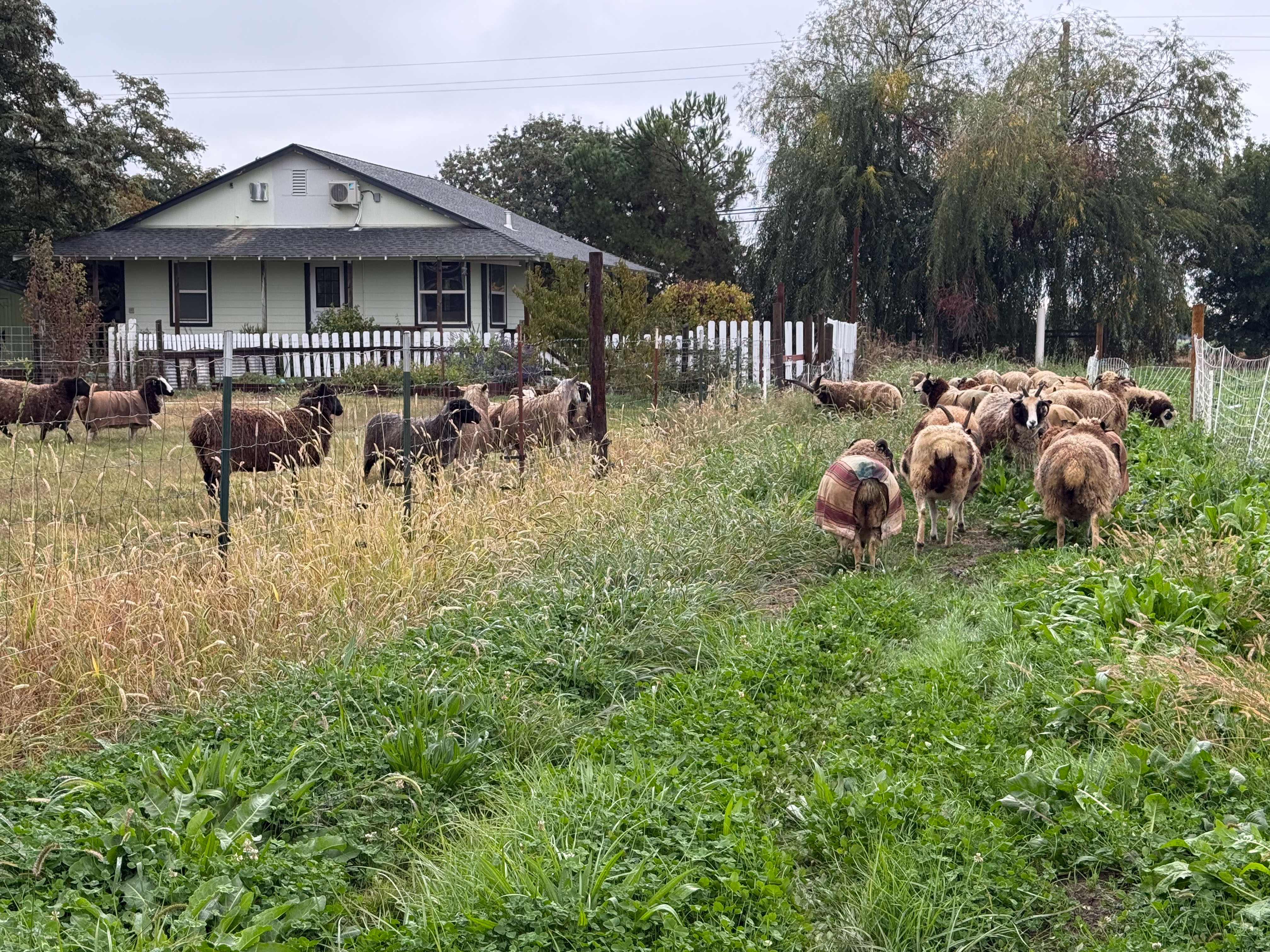
The lane is adjacent to Clancy’s group. However there is hot wire on both sides of the net fence and there doesn’t seem to be any problem with either ram trying to get through.
You may notice some blue marks on the ewes. Those are more noticeable than the orange marks on several, The rams wear marking harnesses so we have a better idea of when to expect lambs. I hadn’t noticed as many marks lately.
Is this why? The rams went in with ewes three weeks ago on September 27. I substituted the orange markers from Clancy and Hornblower with blue markers a week ago. You can see the difference in a new one and the used ones.
Clancy’s group is in the field between the barn and the shop–not one of the renovated pastures. Notice two blue marks. The ewe in the background marked blue was the first one Clancy marked with orange on September 27.
So we now know that she was not pregnant after that breeding. If all the ewes in this group are re-marked that would indicate a problem with the ram. Hopefully that is not the case. The other ewe marked blue in the photo above this one had not been marked before. I’ll keep watching to make sure that more of the oranges aren’t also marked blue in the next week.
Ginny’s birthday was October 12. She just turned 11. I have only about a zillion photos of Ginny so it was time consuming to narrow this down.
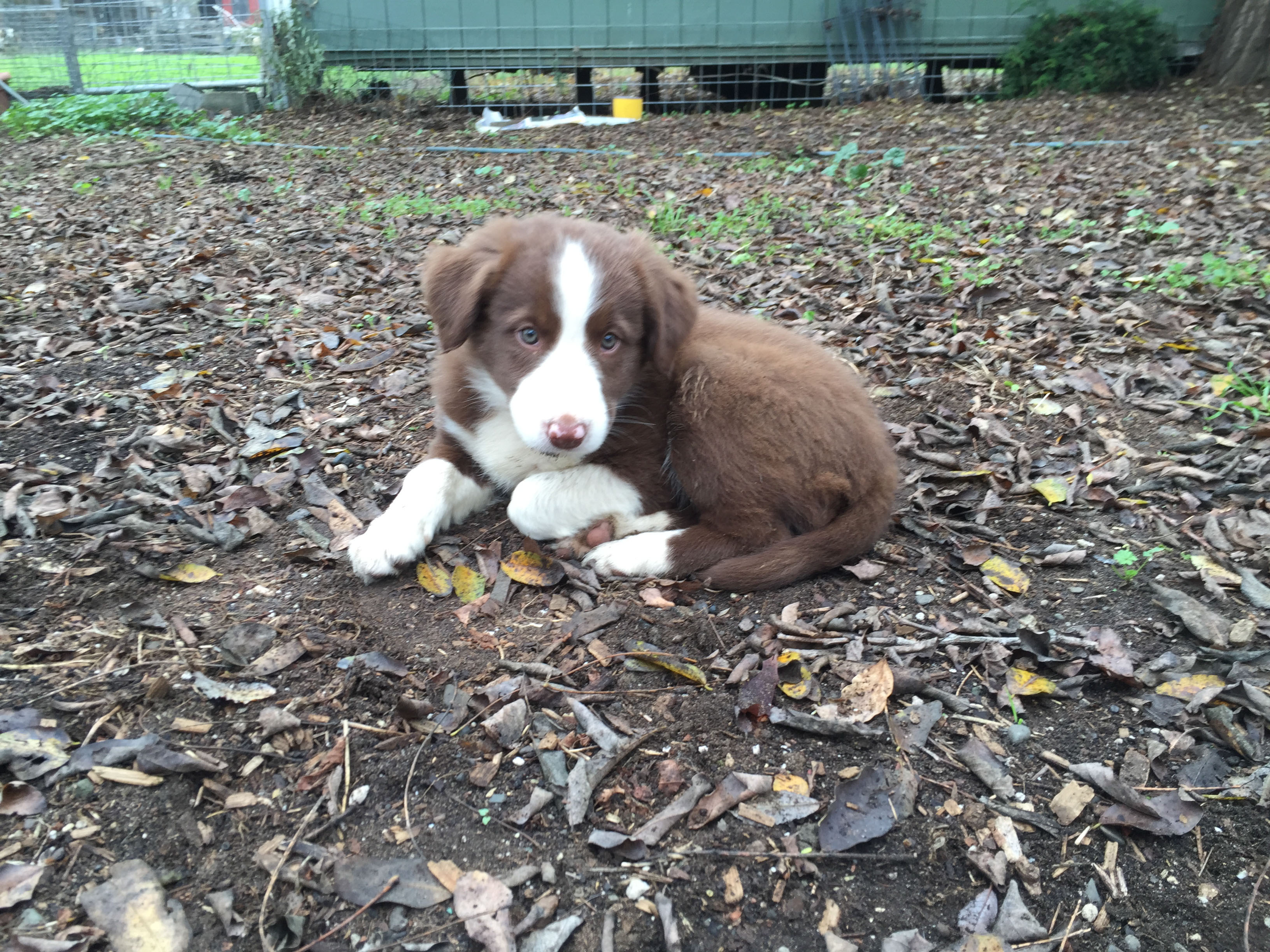
December, 2014. Ginny was two months old.
Many of my photos focus on action with a ball. I wouldn’t say that Ginny is ball-obsessed to the exclusion of all else. On the other hand, she is somewhat ball-obsessed. I have lots of photos taken during our walks Across the Road of Ginny leaping for a ball I have thrown. One reason that there are so many is that I kept trying to get that perfect shot and Ginny was a willing subject over…and over…and over…
I am a sheep farmer and the real reason to have a Border Collie is to help with sheep. That is not necessarily a good time for photos because we are trying to accomplish a task. I don’t have as much work for a dog as the dog would like. We have a small place and pasture management and fencing that makes it easy to move sheep. In recent years my main use of Ginny is to help move rams to catch them or to move the ewes into the barn from the corral. When I need to get sheep out of the pasture it’s usually easy to call them in.
This is a photo from 2018 taken on a walk Across the Road. At that time 5 dogs lived here. Rusty, the first red Border Collie came from Terry Mendenhall, as did Ginny. That’s Maggie at the top of the photo. The two black dogs are Finn and Sawyer who moved to Boise when Chris and Meryl moved.
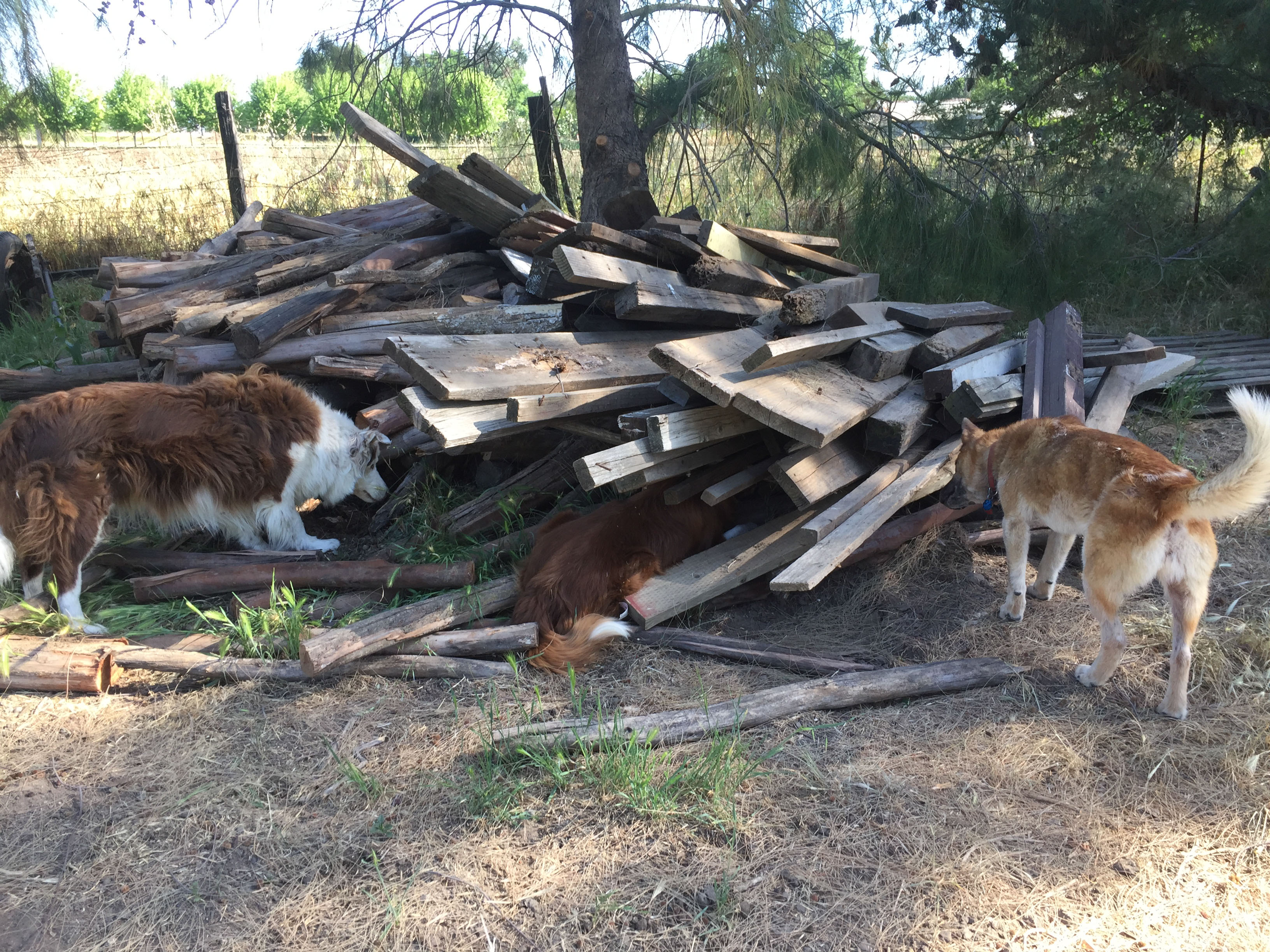
Rusty, Ginny, and Maggie pursuing some kind of critter, probably a ground squirrel that ran into the woodpile.
This was a celebration of Finn’s and Sawyer’s birthday. All dogs had to wait for permission to have their treats.
Ginny in 2019.
Ginny has always created her own entertainment by dropping the ball at the top of the ditch and letting it roll in. I tell her to “get it”, she retrieves the ball, and does it all over again farther up the road.
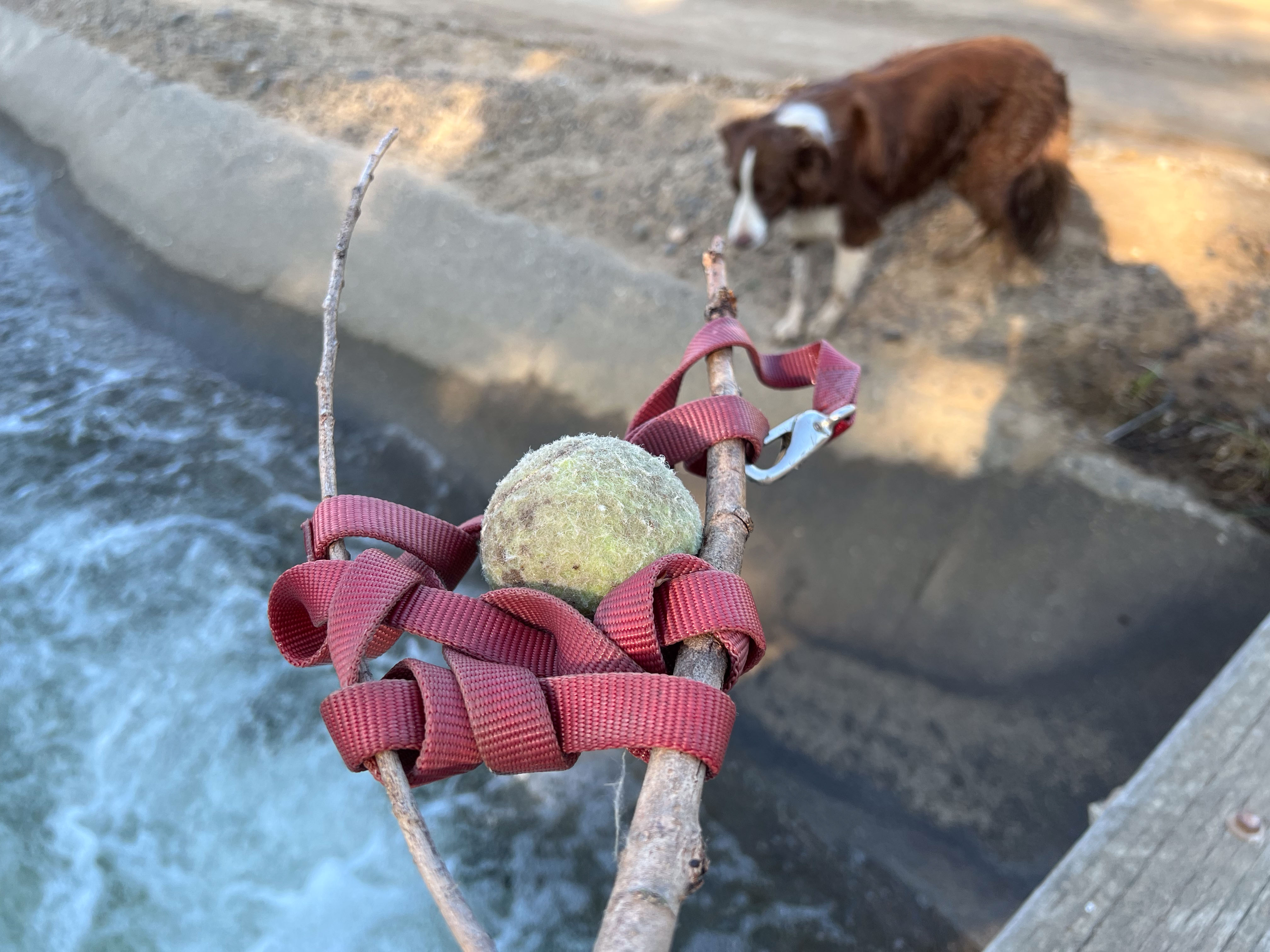
I try to pay attention when we get to the part of the canal that is cement. There are places where the water level drops a couple of feet and the water flows quickly, creating a whirlpool effect at that drop. Ginny can get in and out of the cement canal when the water is not so turbulent, but I don’t want her in this part. She seems to like the game of dropping the ball at those places and then expects me to get it out. The drop-off creates a turbulent whirlpool and the ball disappears and then resurfaces over and over, but doesn’t move downstream. I’m not getting in there and I’m not sending Ginny in. There have been several times when I was able to create a net with a forked stick and the leash, and eventually snag the ball by leaning over the wooden plank that is the walkway over the canal.
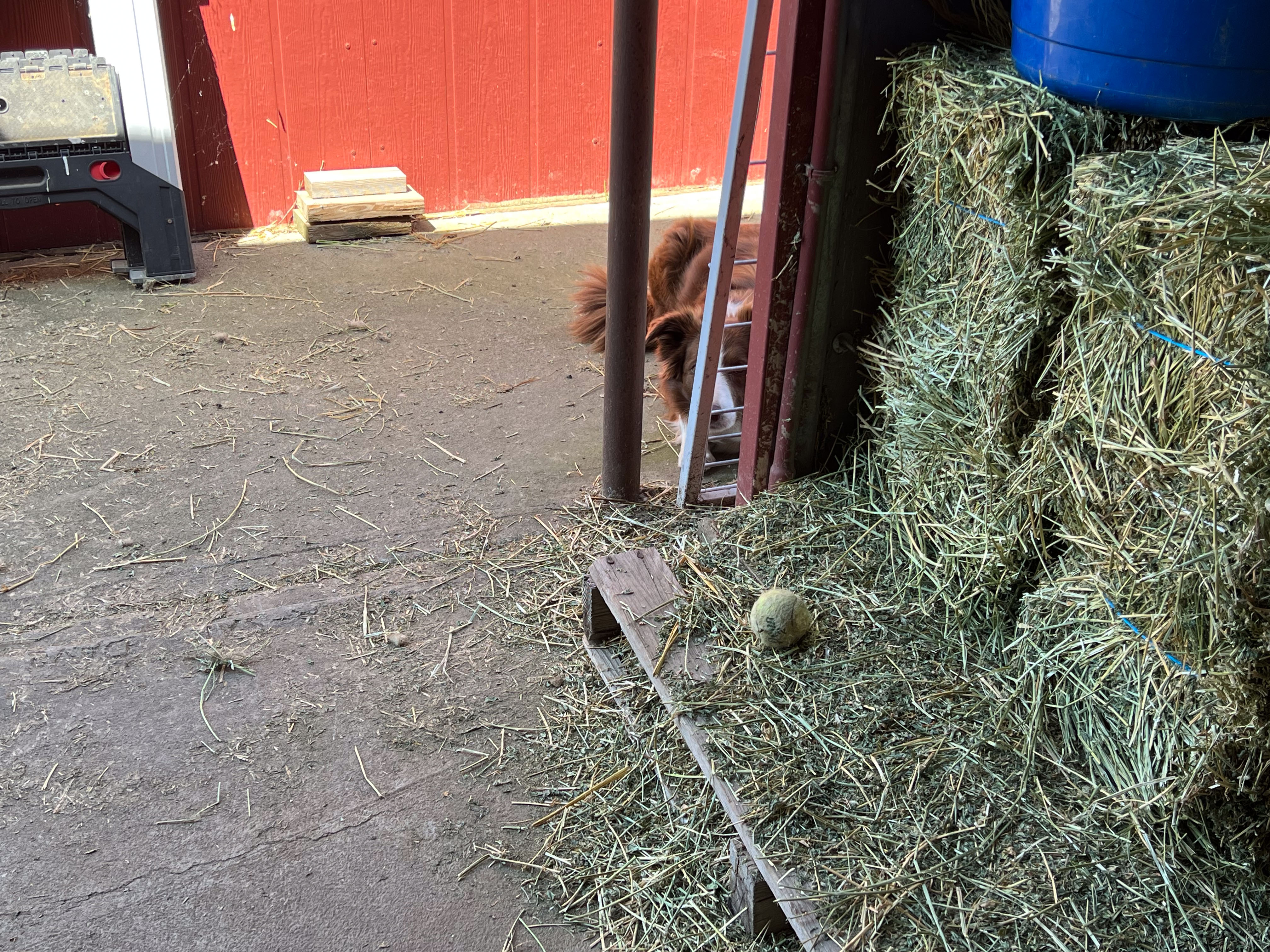
Here is another of Ginny’s habits. When the skirting table is in this part of the barn and I am working Ginny intentionally puts the ball in this spot and then moves behind the wall of the barn and that upright pipe and expects me to get the ball, often barking at me if I haven’t paid attention.
Lambtown was last weekend and Terry was there with her sheep and her older dog that she didn’t want to leave home. This is Jill, Ginny’s mom, who is now 14.
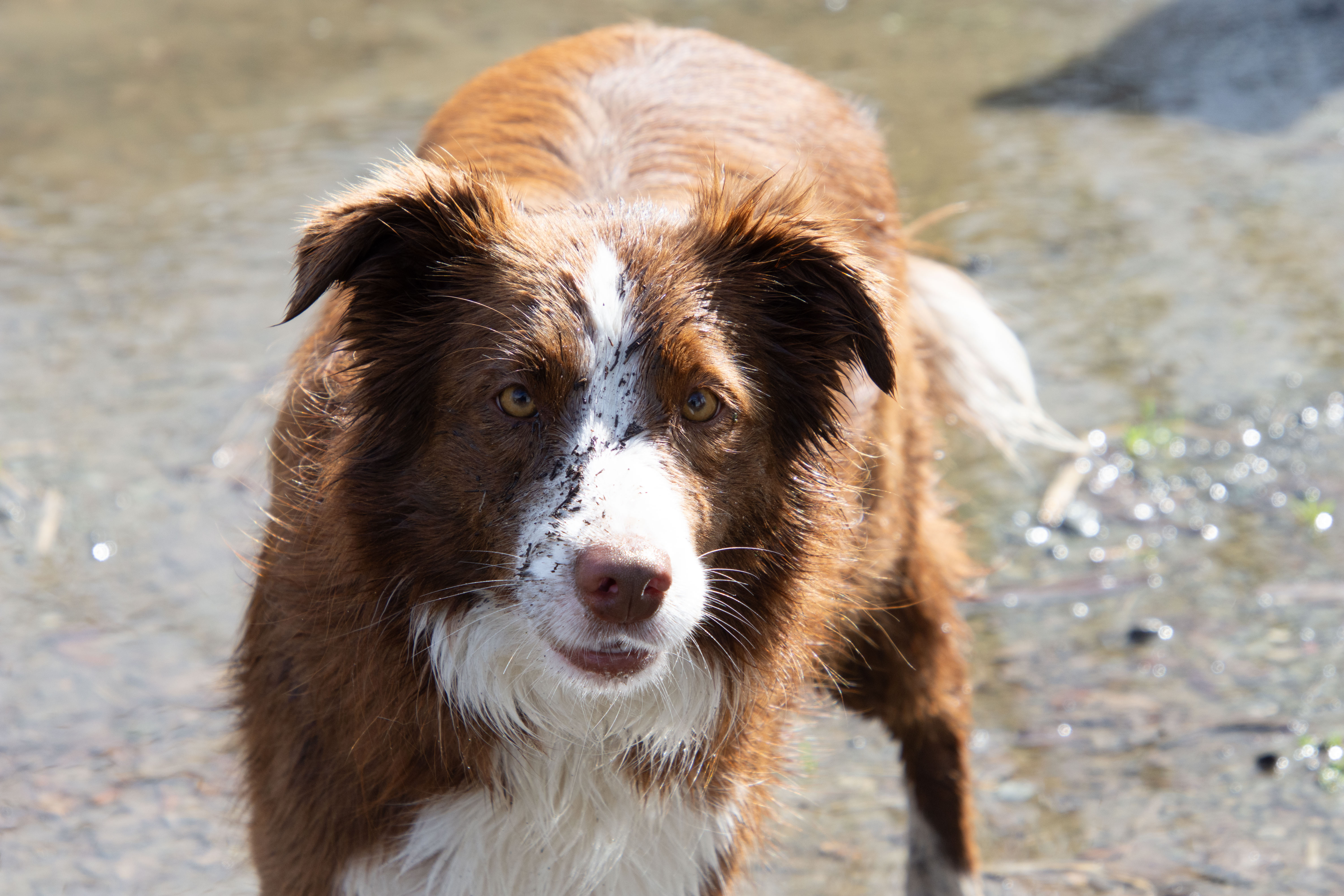
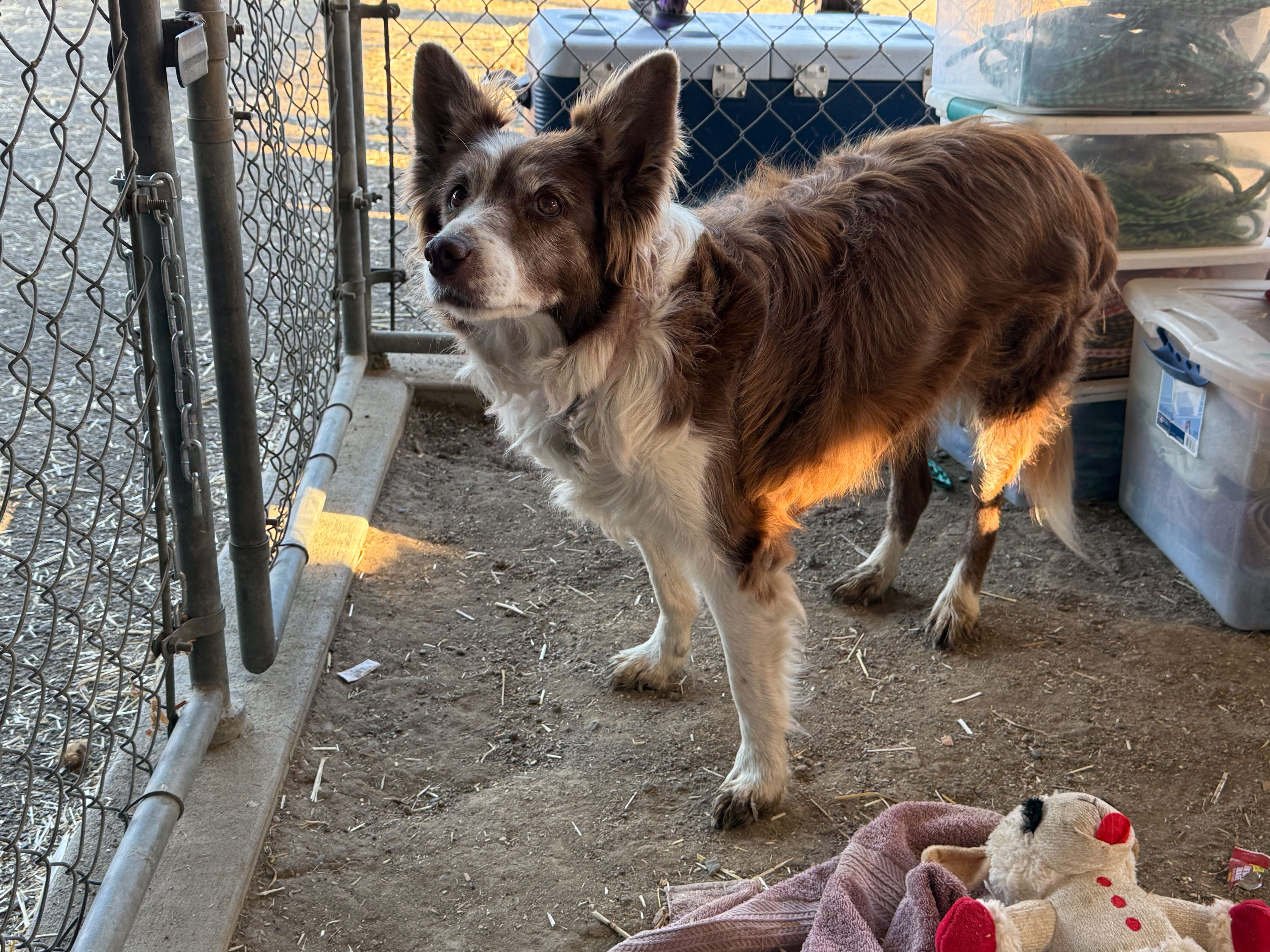
I took this photos of Ginny last week. Looking pretty good for11!
These photos may seem to be unrelated, but that’s how my life is right now…or maybe all the time. Farm Club members were here on Saturday to help set up breeding groups. Too busy to get photos then. Sunday I demonstrated weaving at an alpaca farm for their open house for National Alpaca Farm Day (remembering at 6 the evening before that I needed to get a loom warped for that). Today I worked on lots of odds and ends, mostly working towards being ready for Lambtown this weekend. So this is odds and ends.
Clancy got to work right away on Saturday. (For the record, he is a BFL registered as Liongate Aylan, but I started calling him Clancy because I couldn’t remember that name. Clancy stuck.)
This is one of the ewes I picked up in Napa last week. That’s a story for another blog post when I have time. She is with Clancy’s group.
Indigo is flowering. I spent so much time trying to keep the indigo thriving during the summer that I want to make sure I use more of it for dying before it’s too late.
This is today’s fresh leaf indigo dyepot. That yarn will be blue when it is out of the pot and dry.
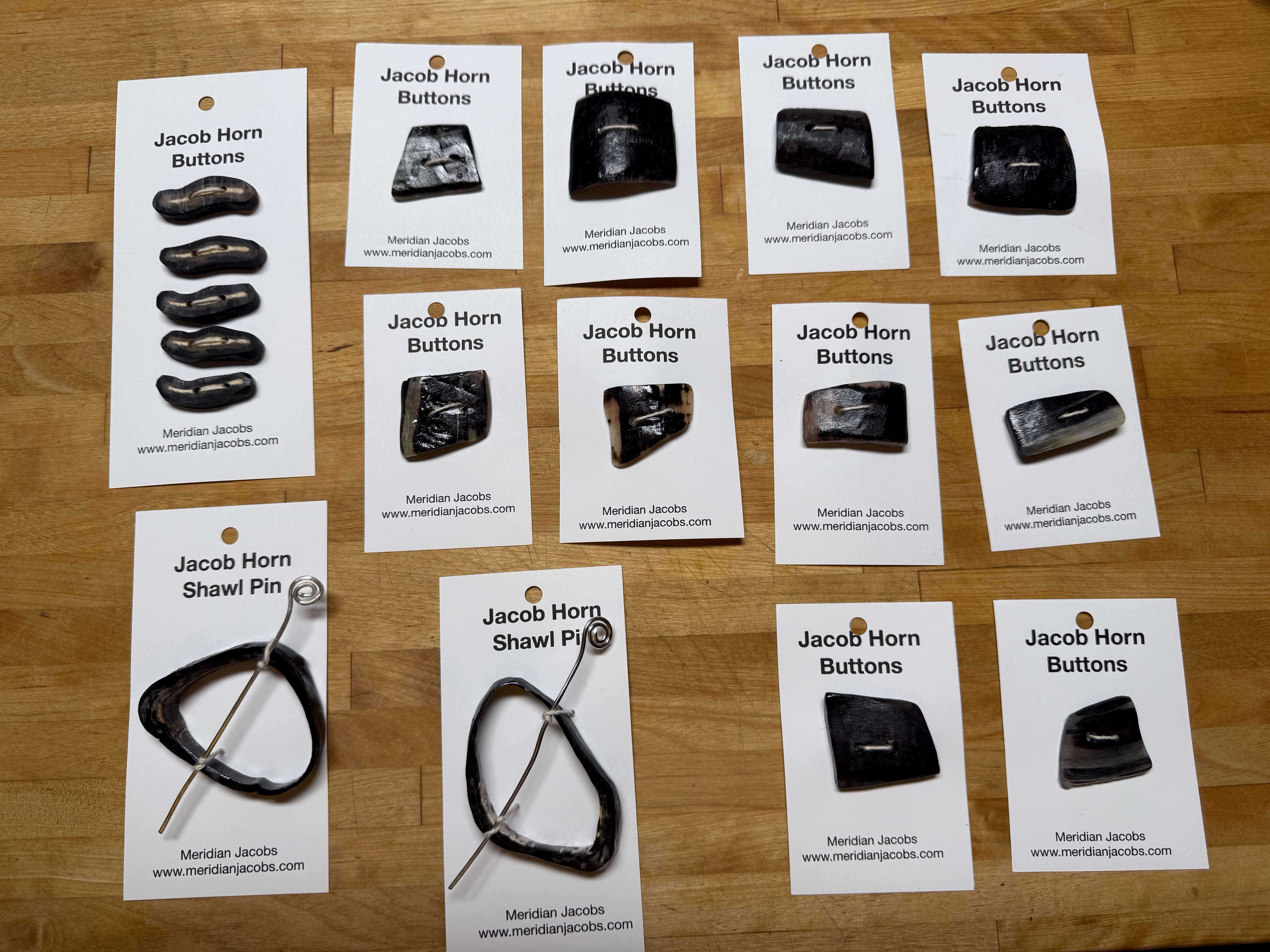
I made buttons over the last few weeks but hadn’t finished them yet. I use lacquer in a satin finish. I could only find semi-gloss locally and had to order what I wanted. There are also two skulls that I cleaned as well as I could and wanted to apply lacquer to the horns.
I load the buttons onto wires that I can dip in the can of lacquer and then spread them to drip and dry. This is one way to get some use out of styrofoam packing material.
These are buttons and shawl pins that I finished a couple of weeks ago. When I couldn’t find the satin lacquer I used semi-gloss and also polyurethane. I think I like the satin finish best, but I’ll find out at Lambtown if it even makes any difference.
I spent a lot of time this week using a new app that will completely remove the background from photos.
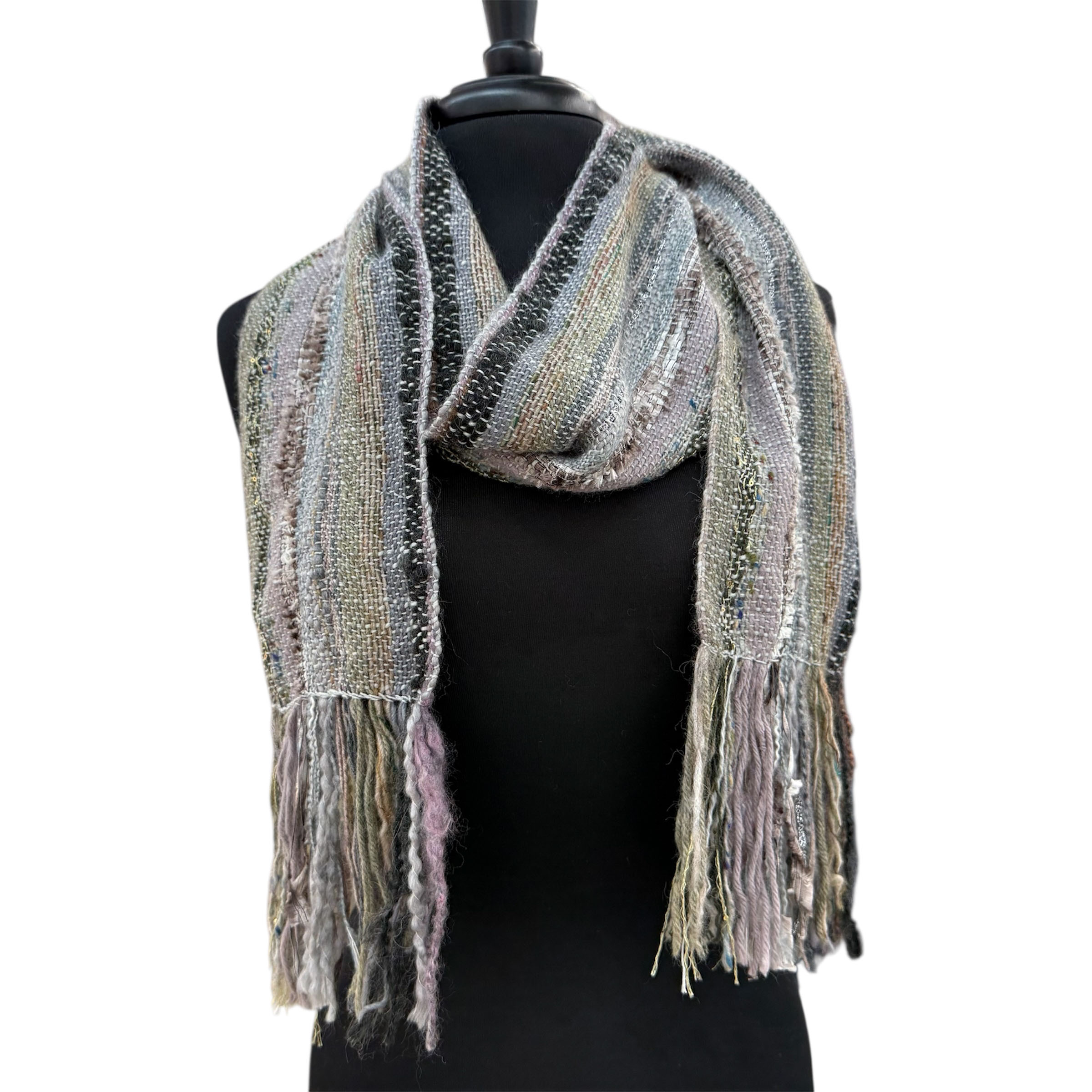
This is another example. I wanted these photos for the new weaving class on my website.
One more sheep thing. I have two registered adult rams that I need to sell. There are four rams out with ewes now and these are extra this year. This one is Hurricane. Rams are on the website here.
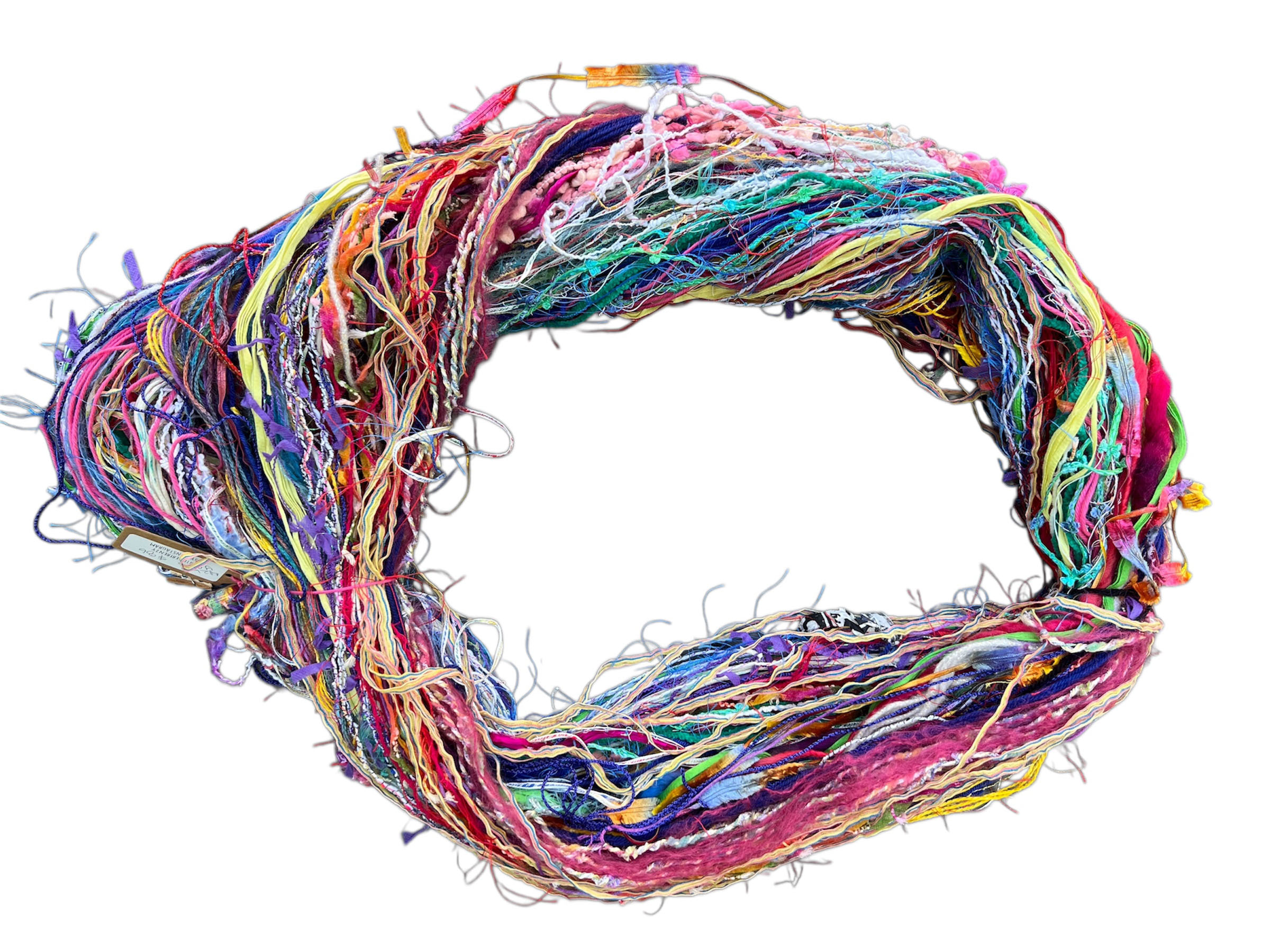
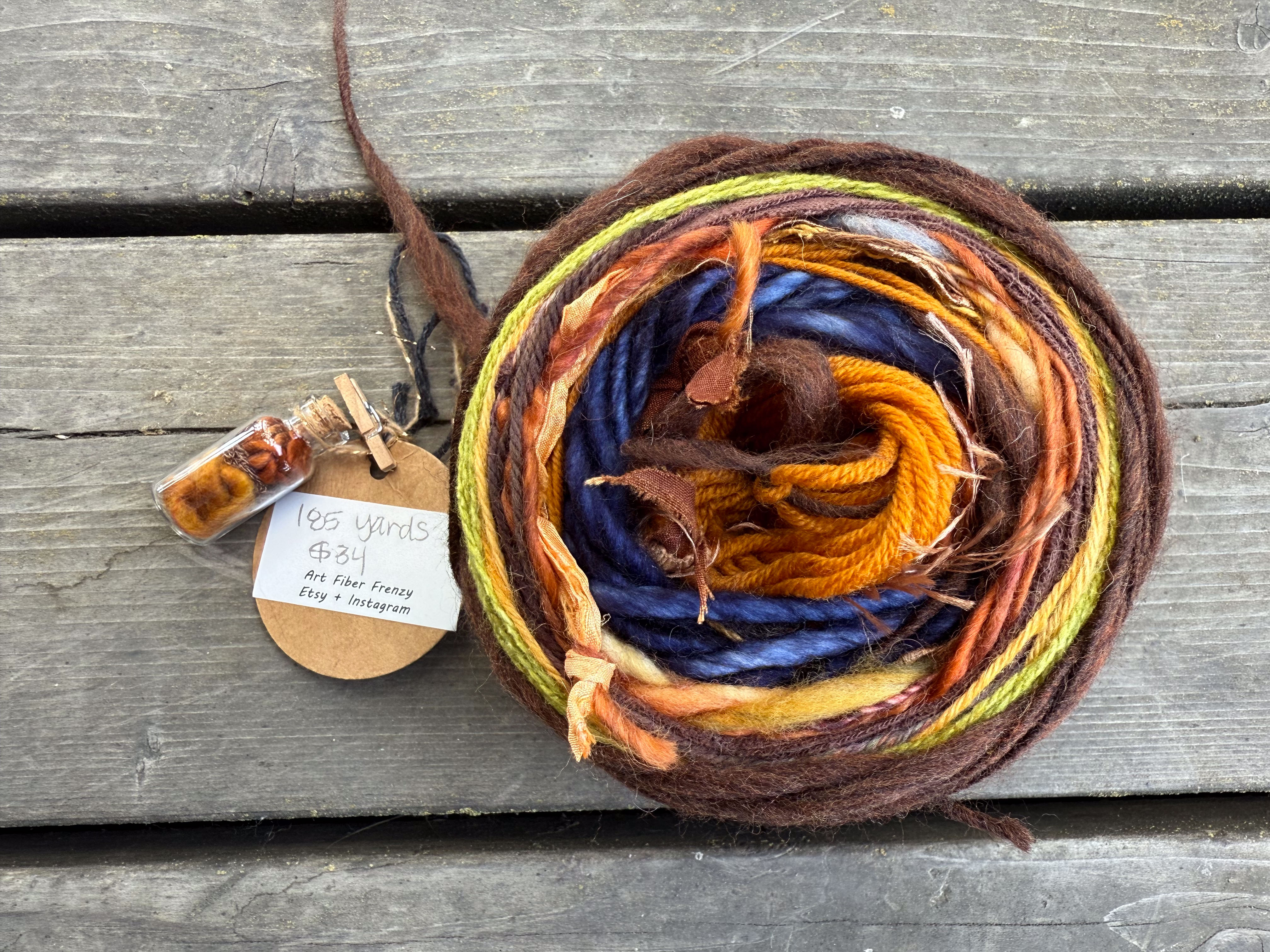
I just listed the Wild and Crazy Weaving class on my website. I’ve been thinking about this awhile, but finally got it done just in time to advertise it at Lambtown coming up October 4-5. I met the creator of Art Fiber Frenzy yarns a couple of years ago at Black Sheep Gathering in Oregon. It turns out that she lives in Sacramento, not far from me, and she will be at Lambtown again this year.
When you closely at this yarn you will see that the random lengths of yarn are tied together. I don’t think the intent was to use this for warp, but that is all that I see. I have figured out the method to turn this into a warp.
The first step is to wind a ball.
This is a step where you don’t want to be sloppy. It was manageable, but not as fun to work with this yarn after my ball turned into many connected balls.
It’s the step of winding warp for which I have developed the best way to deal with the yarn–not just the knots, but all the yarns of different character.
And there is the consideration of sett and weft yarn.
Purchase a skein of yarn from Art Fiber Frenzy and sign up for my class to learn how to weave with it. I have listed one class to teach about a month after Lambtown but plan to teach other sessions of this next year.
I woke up at 5 and thought of things that need to be done. No point in staying in bed.
Rewrite minutes from Tuesday evening’s Artery Board meeting. ✓ Make one more 15′ length of e-net fence so I can switch sheep to another paddock. ✓ Walk across the road with Ginny. ✓ Do a fresh-leaf indigo dye bath to over dye the weld-dyed yellow yarn. ✓ Here are the photos to accompany that check list:
There are 3-wire electric fences every 60 feet in the south pasture. These are charged by attaching to a hot wire at the south border fence. I need to connect a 15′ net fence from that hot wire to these north-south fences. My goal was to have all electric net fences for blocking off the 60′ spaces and the 15′ connection fences in place and not have to move those lengths of fence every time I switch to a new paddock. I have finally accomplished that goal with this morning’s 15′ fence! (I think–maybe I need one more.)
Another accomplishment is to organize and label what’s left. There are three fences that will make up one long north-south fence if I decide to split the 60′ paddock in half lengthwise. The other two bags are leftover but still useable portions of net fence.
Time for a walk Across the Road. This is for Ginny’s mental benefit and for mine. If I go in the morning then all day I can remember that I got at least a little exercise.
This tractor was parked near the hayfield. That tire is taller than I am!
A view of the new paddock from the main road coming back from our walk.
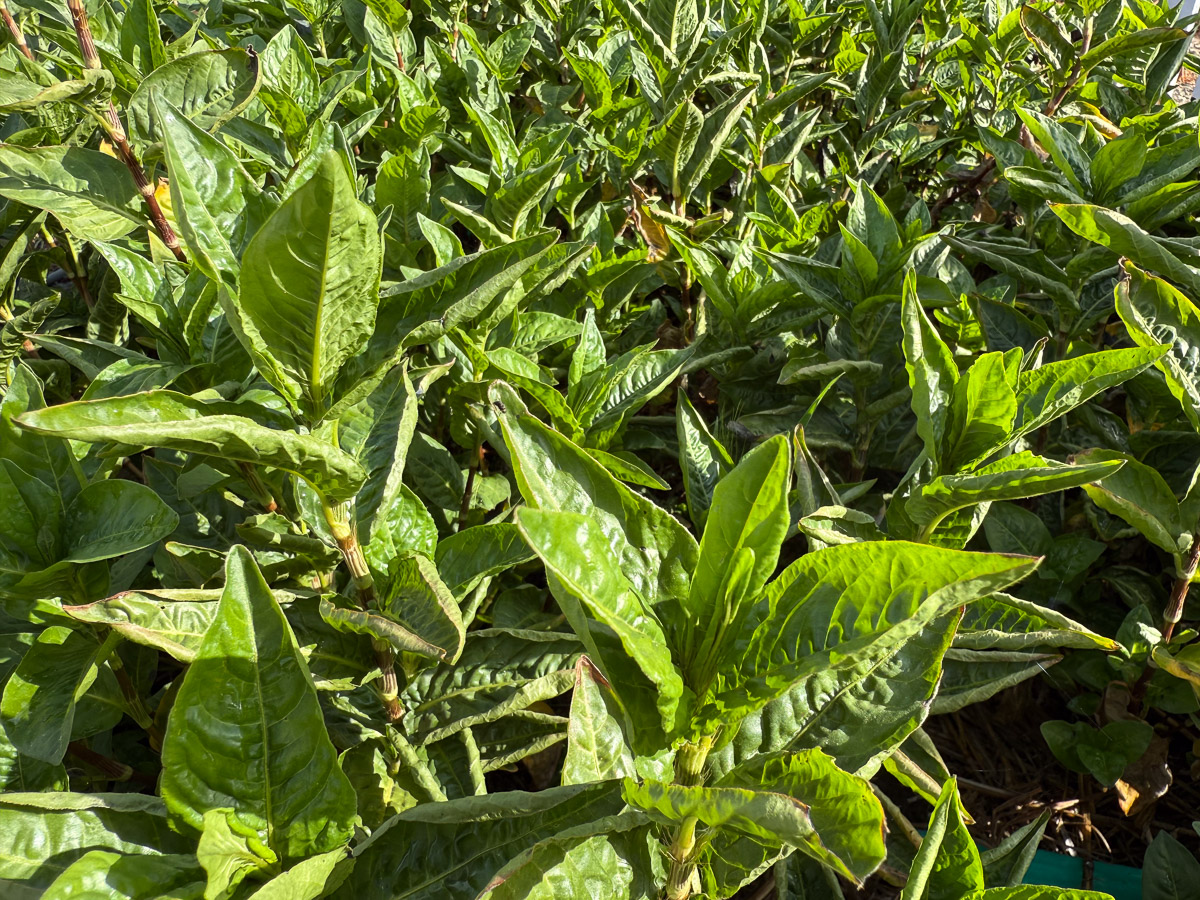
Indigo in the garden.
I harvested about a pound of leaves to overdye the yellow yarn I dyed with weld the day before. I dye with fresh leaves using ice water and a blender. After that dye bath was in place I could move on to something else.
What is the plan for the afternoon? Make more horn buttons ✓ Thread the hemp warp that is on one of the looms. ✓ Photograph all the unfinished pieces for yesterday’s blog post. ✓
I cut more buttons. The next step is to drill holes and then sand. I found some that already had holes but I had not sanded them. Those are in the three cups at the bottom. I keep track of buttons that will match by keeping all from one horn together through the process. I sanded all those that already had holes in them, but still need to drill the others.
While I was working in the barn on buttons we had a hay delivery. This is 88 bales that need to go in the barn.
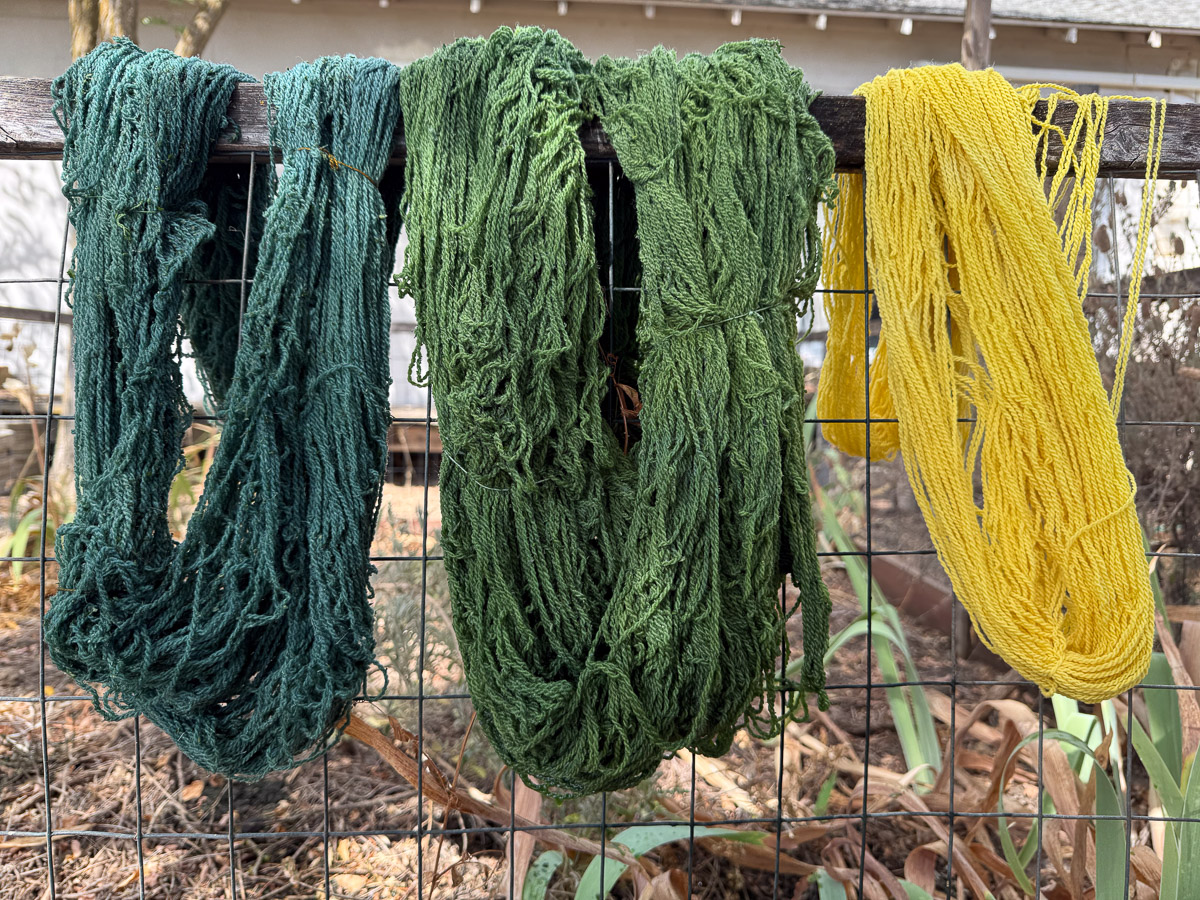
I took the indigo-dyed yarn out of the bucket and hung it up to drip. When I’m finished here I’ll cut apart the bundled skeins so they can dry better. The yellow one is what the green ones looked like before putting in the indigo. The blue yarn was white yarn in the same bucket.
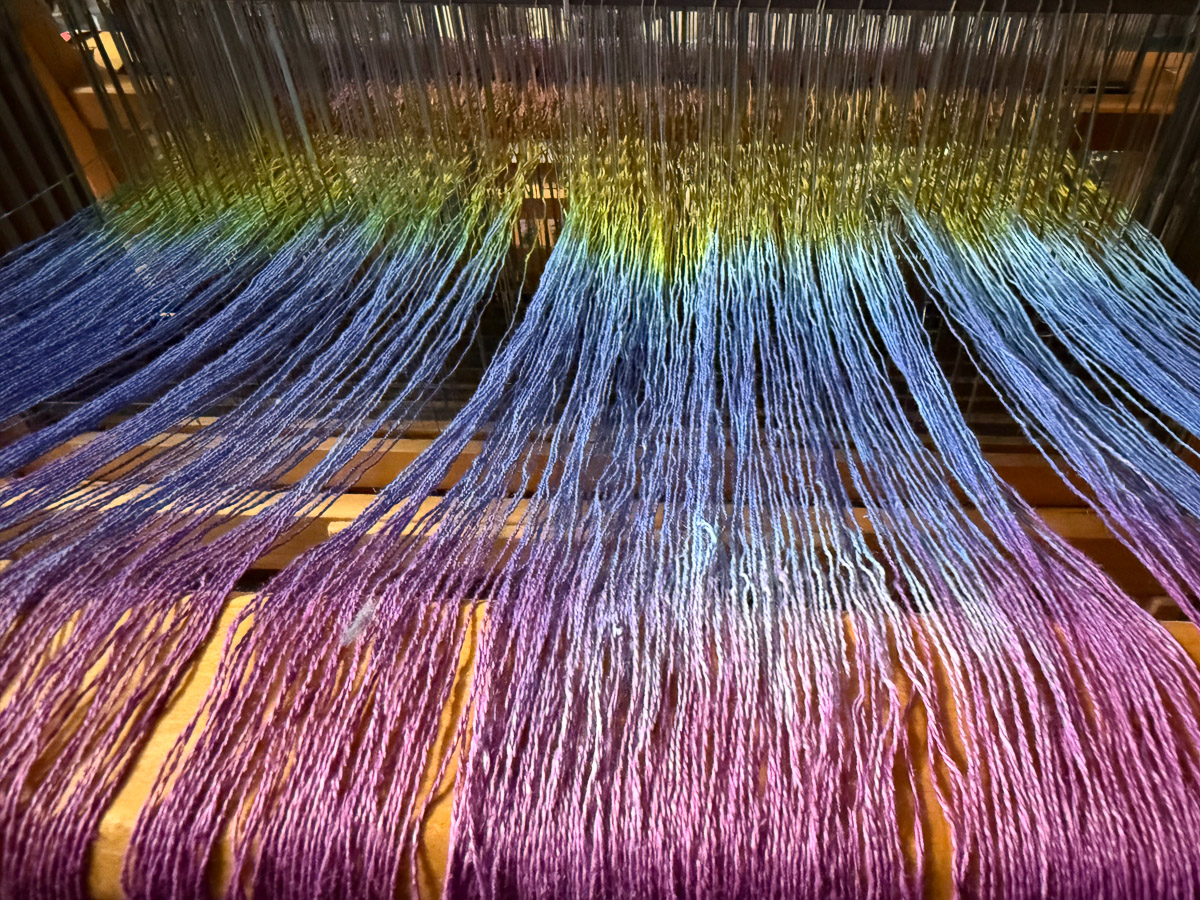
I went to one of the looms in the shop to thread my space-dyed hemp yarn and finished about chore time. Now it’s ready to weave. That is on today’s list, along with sanding those buttons.
I should catch my blog up on the weaving side of life. I am always trying to squeeze weaving into the day. There are a lot of ongoing projects and many that are off the loom but not finished. There is a saying “It’s not finished until it’s wet finished.” Wet finishing is an important part of the process, but there are often other steps between taking the piece off the loom and wet finishing. Here’s a round-up of all the projects that are waiting around to be finished.
These three wool blankets have been off the loom awhile. The one in the middle is ready for wet finishing. So is the one on the right…or maybe not. I am going to sew a hem. I have to decide if I’ll finish the hem before or after wet finishing this time. I usually do it after. The blanket on the left has a warp error the whole length of the blanket that needs to be fixed. I didn’t see that until the blanket was cut off the loom.
These chenille scarves have been off the loom a long time. They need fringes twisted before washing.
Two cotton shawls that need twisted fringe and then washing.
Jacob shawls woven in black and white pinwheels. I think that the pinwheels will square up with wet finishing. They are a bit elongated now. I have twisted the fringe on one of these but need to do that on the upper left. Bottom left doesn’t have fringe and the ends will be sewn together. to create a mobs wrap.
These are just off the loom. I wove the piece on the right first. I dyed the warp last week. This piece has twisted fringe and needs to be washed. I’ll wait until the fringe is finished on the other and run them through the washing machine together. These were on the same warp. The scarf on the right was sett at 10 epi, the sett that I usually use for this Ashford “caterpillar cotton” . Weft is 3/2 cotton. The scarf on the left is sett at 15 epi and weft will be 5/2 cotton.
Now for projects that are on the loom:
I dyed this yarn last week, along with the warp above. This one is hemp and will be dishtowels. I had to fix a threading error today and will have this ready to weaving tomorrow.
Baby blankets underway.
Wool blankets underway. I really want to finish these blankets this week.
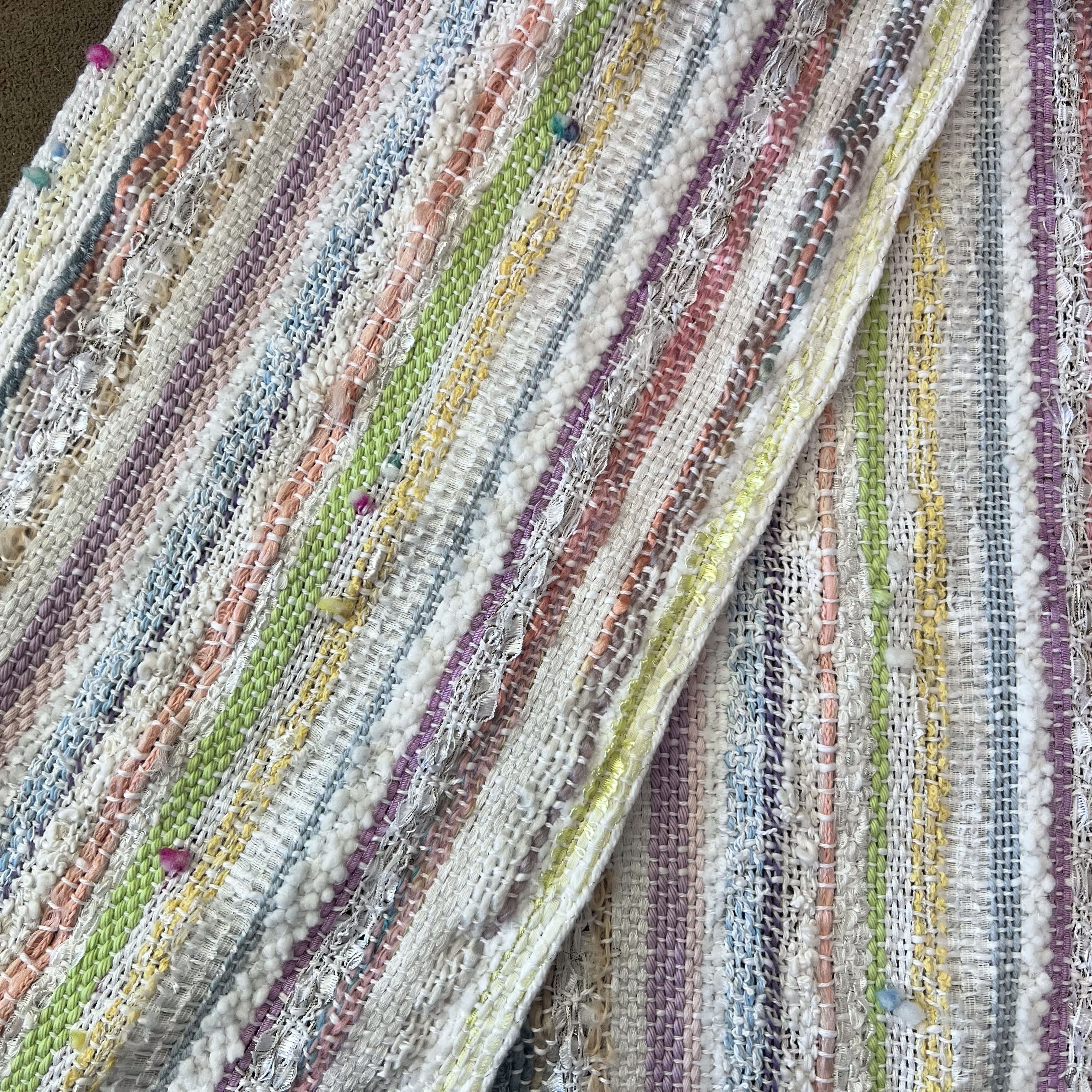
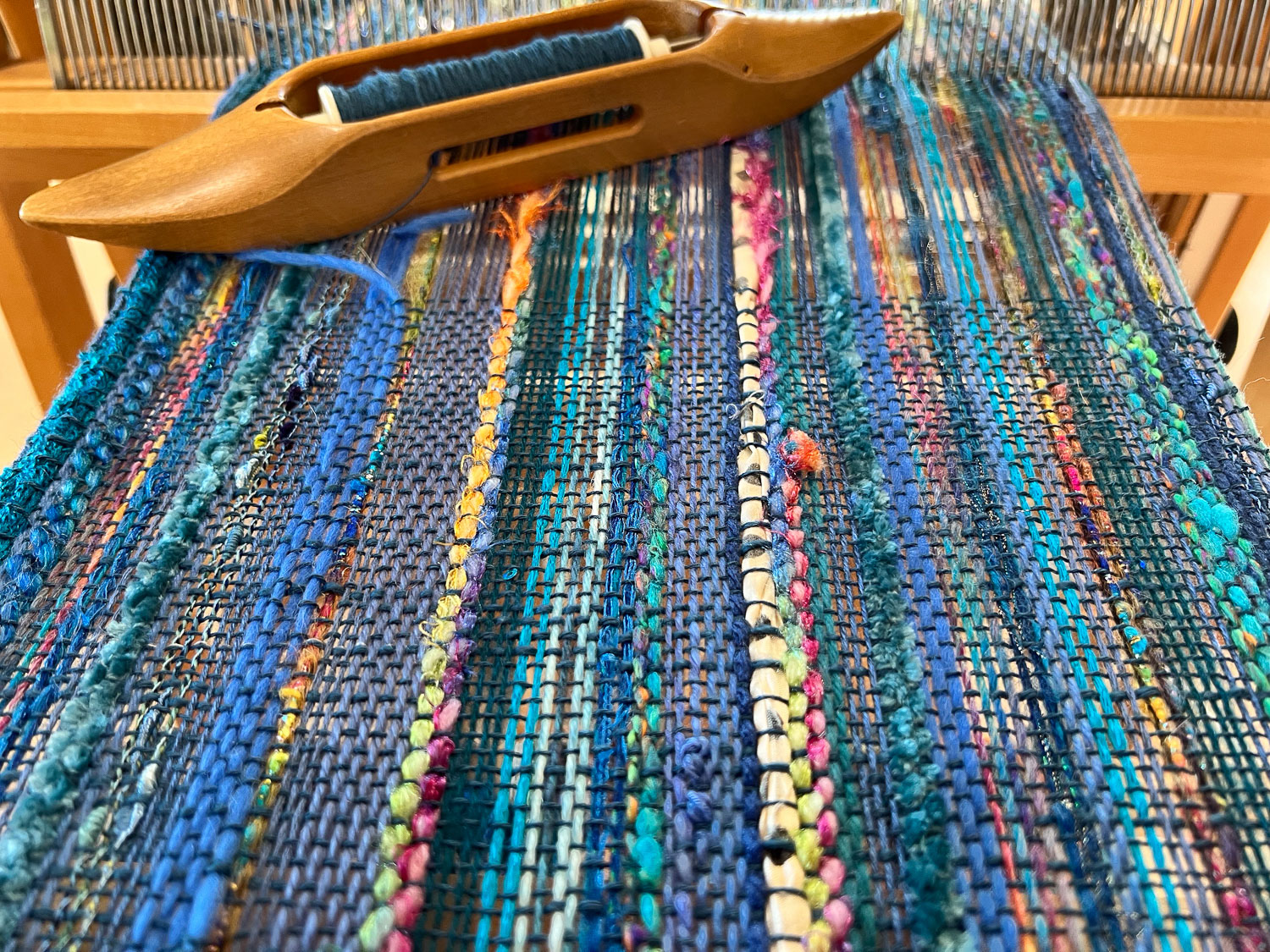
A warp ofj mixed yarns, sourced from Art Fiber Frenzy.
When I wrote a newsletter yesterday I referred to the series of blog posts about the pasture that I wrote over the last year. You can find any of these by searching Pasture and Irrigation Renovation (14 posts) and Grazing and Irrigation (7 posts).
Tonight’s post will follow up on this Grazing and Irrigation post (#7) written in June about May grazing. The pasture looks much different now than it did then.
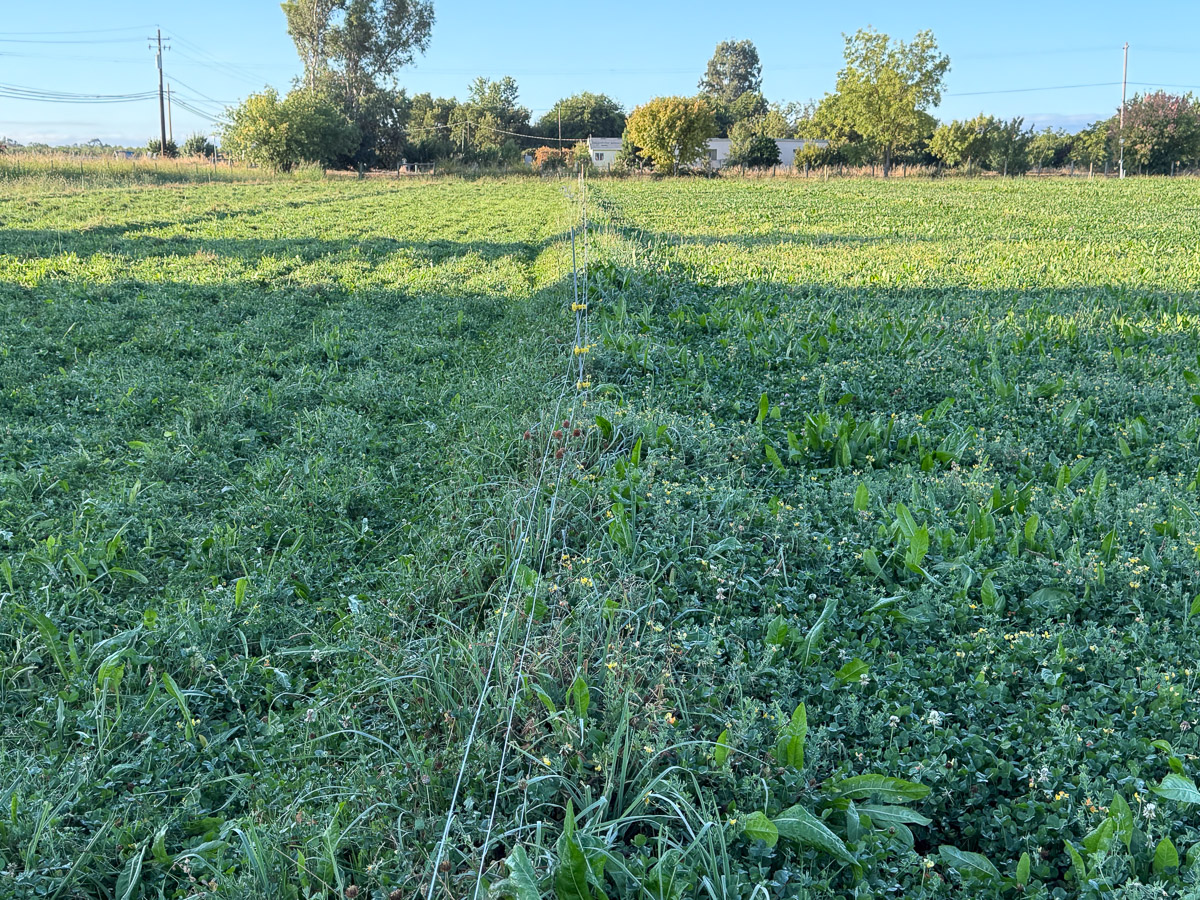
The ryegrass is gone and you see mostly clover.
Next most prominent is birdsfoot trefoil, and more recently the chicory has taken a foothold. Those are the three broadleaf plants that were in our seed mixture. All of the paddocks in the south pasture look like this now. Back in the spring we started topping the ryegrass with the mower before grazing and mowed again after grazing. This prevented the ryegrass from being flattened over the clover and becoming a mulch layer.
The smaller field on the north is different. We didn’t graze early enough and this is where the annual ryegrass had such a head start on the clover and overwhelmed it in places. I took this photo while irrigating two weeks ago. While the pasture was flooded, some of the ryegrass “mulch” floated and I was able to rake a lot of it into piles thinking that I’d be able to move it out with the tractor.
A few days later I realized that I didn’t want to wait until the field dried out enough to use the tractor. I was ready to graze again but the lane was still too muddy. I realized that I could use all that straw to cover up the mud. So I used the wheelbarrow.
I used at least a dozen big loads of ryegrass straw to fill in the lane.
This is Sparky in that north field. Hopefully over the course of winter these bare spots will fill in now the they aren’t covered with mulch.


































 Meridian Jacobs' Blog